The multivariate Gaussian
The bell curve, generalized to many dimensions — and the most important distribution in all of ML. A mean vector and a covariance matrix describe it completely, and that single object underlies GMMs, Gaussian processes, VAEs, Kalman filters, and anomaly detection.
What you'll learn
- The density formula and its heart: the squared Mahalanobis distance (x−μ)ᵀΣ⁻¹(x−μ)
- How the covariance matrix Σ controls the shape — round, axis-aligned, or tilted
- Why the Gaussian is special: marginals, conditionals, and linear maps all stay Gaussian
- Mahalanobis distance as "distance in standard deviations" for correlated data
- Where it shows up — GMMs, Gaussian processes, VAEs, Kalman filters, anomaly detection
Before you start
The last lesson ended with a shape but no distribution: the covariance matrix Σ drew an ellipse, yet could not say how likely any single point was.
Here is the distribution that fills that ellipse in. The 1-D normal is everywhere because of the Central Limit Theorem. Its multi-dimensional cousin — the multivariate Gaussian — is even more central to ML, because it is the one rich distribution we can actually compute with.
And it is described by exactly the two things you already hold: a mean vector μ (where the
blob sits) and a covariance matrix Σ (its shape and tilt).
The density
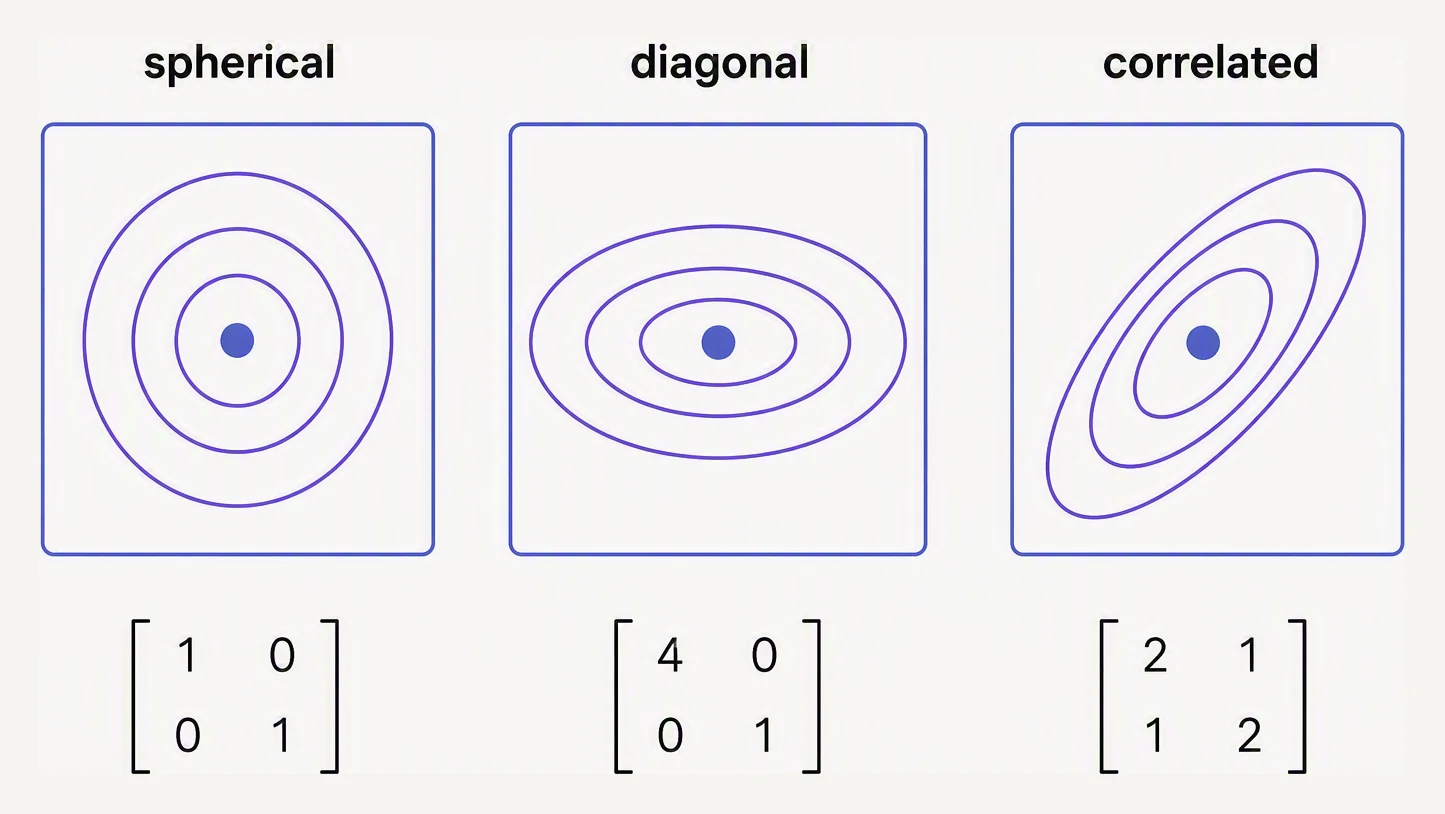
The covariance matrix decides the ellipse: its width, its height, and its tilt.
p(x) = (1 / Z) · exp( −½ (x − μ)ᵀ Σ⁻¹ (x − μ) )Ignore the normalizer Z. The action is in the exponent: that quadratic
form (x − μ)ᵀ Σ⁻¹ (x − μ) is the squared Mahalanobis distance — how
far x is from the mean, measured in the distribution’s own stretched,
tilted units.
Points at equal Mahalanobis distance form an ellipse, and those ellipses are the contours of the bell.
Positive ρ: the blob tilts up — high x tends to mean high y.
One mean vector, one covariance matrix Σ — that's the entire description. Σ rotates and stretches a circular bell into this ellipse.
Σ does all the shaping. Σ = σ²I gives a perfectly round bell (isotropic).
A diagonal Σ gives an axis-aligned ellipse. A full Σ tilts it — exactly
the correlation you tuned.
Why the Gaussian is the distribution we use
It has almost magical closure properties:
- Marginals are Gaussian. Ignore some dimensions — what’s left is still Gaussian.
- Conditionals are Gaussian. Fix some variables and the distribution of the rest is Gaussian. This is the engine of Gaussian processes and Kalman filters — “given what I’ve seen, predict the rest.”
- Linear maps preserve it.
Ax + bof a Gaussian is Gaussian. Stays closed under the operations neural nets and signal processing use.
No other multivariate distribution is this tractable — which is why we reach for it constantly, even as an approximation.
import numpy as np

rng = np.random.default_rng(0)

mu = np.array([0.0, 0.0])
Sigma = np.array([[1.5, 1.0], [1.0, 1.0]])     # correlated

X = rng.multivariate_normal(mu, Sigma, size=5)
print("samples:\n", X.round(2))

# Mahalanobis distance: how many "stretched std-devs" from the mean?
Si = np.linalg.inv(Sigma)
def maha(x): return float(np.sqrt((x-mu) @ Si @ (x-mu)))
print("\npoint [3,0]  Euclidean:", round(np.hypot(3,0),2), " Mahalanobis:", round(maha([3,0]),2))
print("point [0,3]  Euclidean:", round(np.hypot(0,3),2), " Mahalanobis:", round(maha([0,3]),2))
# same Euclidean distance, very different Mahalanobis -- Sigma rescales space
samples:
[[-0.11 -0.17]
[-0.79 -0.56]
[ 0.53 0.63]
[-1.83 -0.86]
[ 1.2 0.19]]
point [3,0] Euclidean: 3.0 Mahalanobis: 4.24
point [0,3] Euclidean: 3.0 Mahalanobis: 5.2Both test points are 3 units from the mean in plain distance, but their
Mahalanobis distances differ — because Σ says the data spreads more easily
in one direction than the other.
Where this lives in ML
- Gaussian Mixture Models model data as several Gaussians — soft clustering and density estimation.
- Gaussian processes put a Gaussian over functions; prediction is just a Gaussian conditional.
- VAEs use a Gaussian latent prior and a Gaussian encoder.
- Anomaly detection flags points with large Mahalanobis distance.
- Diffusion models literally add and remove multivariate Gaussian noise.
In one breath
The multivariate Gaussian is the bell curve in many dimensions, fixed by just a mean vector μ (centre) and a covariance matrix Σ (shape and tilt).
Its density p(x) ∝ exp(−½ (x−μ)ᵀ Σ⁻¹ (x−μ)) carries the squared Mahalanobis distance in the exponent — distance from the mean in the distribution’s own stretched, tilted units.
So equal-probability contours are ellipses:
- round when
Σ = σ²I - axis-aligned when Σ is diagonal
- tilted when it’s full
It dominates ML for one reason: closure. For a Gaussian, these all stay Gaussian:
- marginals
- conditionals
- linear maps
That is the exact property behind:
- Gaussian processes
- Kalman filters
- GMMs
- VAEs
- anomaly detection
- (assume Gaussian errors) why least-squares MSE is the default loss.
Practice
Quick check
A question to carry forward
Twice now we have leaned on the same unexplained claim: the Gaussian is everywhere “because of the Central Limit Theorem.” We invoked it to justify reaching for the bell curve constantly — but a justification you keep citing without proving is a debt, and it is time to pay it.
It is a genuinely astonishing fact, so it deserves to be stared at directly. Take any distribution at all — a lopsided die, a skewed income, a single coin flip — draw many independent samples and average them.
The distribution of that average is not lopsided, skewed, or two-valued; it is a smooth, symmetric bell, and it grows more bell-shaped the more you average. The shape of the originals barely matters.
Here is the thread onward:
- what exactly is the Central Limit Theorem?
- why does averaging launder almost any distribution into a Gaussian?
- why is that — not coincidence — the reason the following turn out normal?
- measurement errors
- sample means
- half the quantities in statistics
Practice this in an interview
All questionsA GMM fits a weighted set of Gaussian distributions and gives each observation posterior membership probabilities, while k-means assigns it to one nearest centroid using squared Euclidean distance. Prefer a GMM for overlapping, elliptical, or unequal-variance clusters and density-based decisions; prefer k-means when speed, simplicity, and hard assignments matter.
EM fits a GMM by alternating two steps: the E-step computes each point's responsibility (posterior probability) under each Gaussian using current parameters, and the M-step updates the means, covariances, and mixing weights to maximize the expected log-likelihood given those responsibilities. It iterates until the likelihood converges. Because the objective is non-convex, EM only reaches a local optimum, so initialization and multiple restarts matter.
The Normal distribution is justified by the Central Limit Theorem — averages of large i.i.d. samples converge to Normal regardless of the underlying distribution. It is fully characterized by mean and variance, enabling closed-form inference. It fails for heavy-tailed data, skewed outcomes, bounded quantities, and rare extreme events.
Each distribution has a natural generative story: Bernoulli is a single coin flip; Binomial sums Bernoullis; Poisson counts rare arrivals; Normal emerges from sums of many small effects; Exponential models waiting times between Poisson events; Uniform assigns equal probability across a range. Choosing correctly comes from matching that story to the data-generating process.