Constrained optimization & Lagrange multipliers
Most ML optimization comes with strings attached — keep the weights small, keep the probabilities summing to one, classify everything correctly. Lagrange multipliers turn "optimize subject to a rule" into a single elegant equation, and they're the math behind SVMs, regularization, and PCA.
What you'll learn
- Why so much of ML is constrained optimization, not free optimization
- The geometric heart: at the optimum, ∇f and ∇g are parallel
- The Lagrangian and how it turns a constrained problem into an unconstrained one
- A first look at KKT — what changes when constraints are inequalities
- How this powers SVMs (support vectors), regularization (λ), and PCA (eigenvalues)
Before you start
The last lesson closed by noting that every method so far roamed freely, while real problems come fenced in: minimise the loss, yes — but subject to a rule. The rest of this course is full of them:
- Minimise loss subject to
‖w‖² ≤ c(don’t let the weights explode). - Maximise the margin subject to every point classified correctly (SVM).
- Maximise likelihood subject to the probabilities summing to 1.
- Maximise variance subject to the direction being a unit vector (PCA).
Lagrange multipliers are the one idea that handles all of these — and, as you will see, the
“price” they attach to a constraint turns out to be exactly the λ you already tune in ridge.
The geometric insight
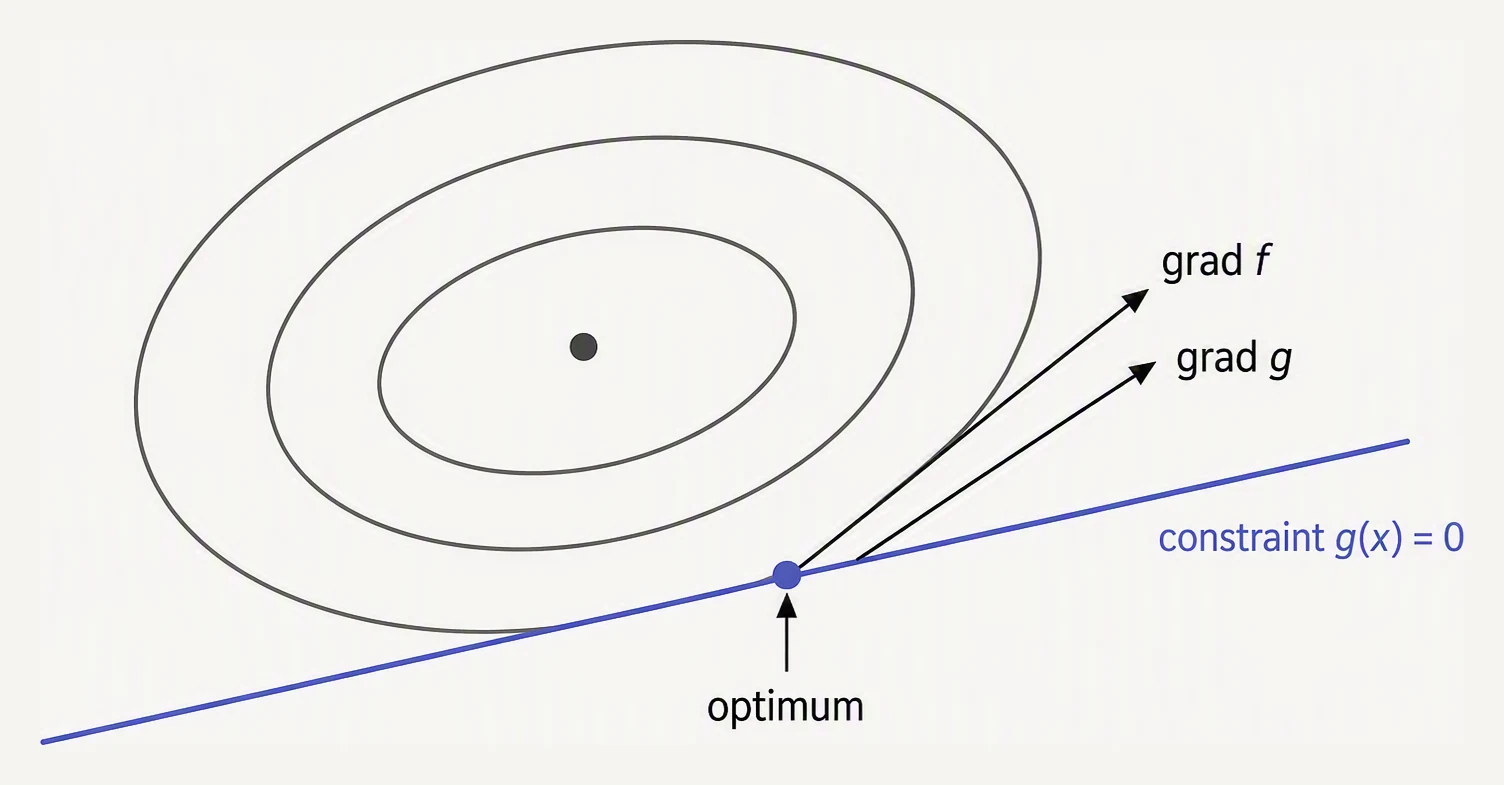
The optimum is where the contour just kisses the constraint.
You’re minimizing f but you’re locked onto the constraint surface g = 0.
At the best allowed point, you can’t lower f any further without stepping
off the constraint. This happens exactly when the level curve of f is
tangent to the constraint — and tangency means the two gradients point along
the same line:
∇f = λ ∇gλ (the Lagrange multiplier) is just the scaling factor between them.
Stay on the circle g = 0, get as close as you can to the target. The best spot ● is where the dashed objective curve just touches the circle.
There, ∇f and ∇g point along the same line:
Drag the target. Wherever it goes, the optimum keeps the two gradients parallel — that's the whole method.
The Lagrangian: one function to rule them
Bundle the objective and the constraint into a single Lagrangian:
L(x, λ) = f(x) − λ · g(x)Set all its partial derivatives to zero. The x-derivatives give
∇f = λ∇g (tangency); the λ-derivative gives back g(x) = 0 (stay on the
constraint). A constrained problem in x became an unconstrained
stationary-point problem in x and λ together.
import numpy as np

# Minimize f = (x - T).(x - T) on the circle ‖x‖ = R  (closest point on a circle)
T = np.array([2.0, 1.3]); R = 1.8

x_star = R * T / np.linalg.norm(T)            # the analytic optimum
grad_f = 2 * (x_star - T)                      # ∇f at the optimum
grad_g = 2 * x_star                            # ∇g (circle constraint)

# They must be parallel: grad_f = λ grad_g  ->  cross product ≈ 0
lam = grad_f[0] / grad_g[0]
print("optimum:", x_star.round(3))
print("∇f =", grad_f.round(3), "  ∇g =", grad_g.round(3))
print("parallel? cross =", round(grad_f[0]*grad_g[1] - grad_f[1]*grad_g[0], 6), " λ =", round(lam, 3))
optimum: [1.509 0.981]
∇f = [-0.982 -0.638] ∇g = [3.018 1.962]
parallel? cross = -0.0 λ = -0.325The optimum is the point on the circle closest to T, and the readout proves
the geometry: ∇f and ∇g have a cross product of zero — they are
parallel. It also shows that λ = −0.325 is the single constant linking
them. The sign of λ just reflects that here we minimised toward a point inside
the circle.
Inequalities: a peek at KKT
When the constraint is g(x) ≤ 0 instead of = 0, the KKT conditions
generalize the idea. The key new rule is complementary slackness:
λ ≥ 0 and λ · g(x) = 0.
In plain terms — either the constraint is active (you’re pressed against
it, g = 0, λ > 0) or it’s slack (you’re safely inside, so λ = 0 and
it doesn’t matter). This single rule is what defines an SVM’s support
vectors.
Where this lives in ML
- SVMs. Maximizing the margin under “classify everything correctly” is a constrained problem; its Lagrangian dual is what you actually solve. The points with non-zero multipliers are the support vectors — the only ones that matter.
- Regularization. “Minimize loss subject to
‖w‖² ≤ c” and “minimize loss+ λ‖w‖²” are the same problem —λis literally the Lagrange multiplier of the constraint. That’s why ridge’sλand a hard norm budget are two views of one idea. - PCA. “Maximize variance
vᵀΣvsubject to‖v‖ = 1” has Lagrangian givingΣv = λv— the eigenvalue equation. The principal directions are the Lagrange-stationary directions.
In one breath
Most ML optimization is constrained — minimise or maximise subject to a
rule — and Lagrange multipliers crack it with one geometric fact: at the best
allowed point, the objective’s level curve is tangent to the constraint.
Their gradients therefore align, ∇f = λ∇g. Bundle them into the Lagrangian
L(x, λ) = f(x) − λg(x), set every partial to zero, and a constrained problem
becomes an ordinary stationary-point problem in x and λ together.
For inequality constraints, KKT adds complementary slackness (λ ≥ 0,
λ·g = 0 — a constraint is either active or slack), which is exactly what
singles out an SVM’s support vectors. And λ is a shadow price: ridge’s
regularization strength is the Lagrange multiplier of a weight budget, and
PCA’s Σv = λv is a Lagrangian in disguise.
Practice
Quick check
A question to carry forward
That closes the calculus half of the course. Look back at its whole arc:
- the derivative told us which way to step;
- the gradient pointed downhill in a million dimensions;
- backprop computed it for free;
- the Hessian read the curvature;
- convexity guaranteed a single bottom;
- Lagrange multipliers fenced the search onto a constraint.
Every one of those tools answered the same kind of question — given a loss, how do I find the parameters that minimise it?
But sit with the words “given a loss.” We never asked where the loss comes from, and we quietly pretended the data was fixed and known. It is neither.
Real data is noisy, partial, and random — a click that may or may not land, a
measurement smeared by error, a label that is right only nine times in ten.
Before you can minimise an expected loss you must know what “expected” even
means. Before you can read a classifier’s 0.87 you must know it is a
probability.
Here is the thread into the next chapter: what is a random variable, and what
three rules does every probability obey? It also asks why independence and
conditioning — the gulf between P(A|B) and P(B|A) — are the quiet engine
beneath every classifier output, every A/B test, and every loss you have spent
this chapter minimising?
Practice this in an interview
All questionsL1 adds the sum of absolute coefficient values to the loss, which drives some coefficients to exactly zero and performs implicit feature selection. L2 adds the sum of squared coefficients, which shrinks all weights proportionally but rarely zeroes any out. Lasso is preferred when you suspect only a few features matter; Ridge is preferred when most features contribute small effects.
Work top-down: start at the model layer with quantization, distillation, or routing cheaper models for easy requests, since model choices drive every downstream cost. Then optimize the runtime with batching, caching, and techniques like prompt caching for LLMs, and finally match infrastructure to the load using autoscaling on queue depth and spot or batch capacity. Track cost per token or per prediction alongside latency percentiles and accuracy so optimizations never silently degrade quality.
Apply FinOps to ML by tagging every workload (training jobs, endpoints, GPU pools) by team, model, and environment so cost is attributable, then track unit-economics metrics like cost per prediction or per training run rather than just total spend. Set budgets and alerts, identify idle GPUs and overprovisioned endpoints, and enforce guardrails like autoscaling and instance-type policies. The goal is continuous visibility and accountability so teams optimize cost without killing experimentation.
L1 and L2 both reduce variance by penalizing large coefficients, usually adding some bias in return. L1 can set coefficients exactly to zero, while L2 shrinks correlated features more smoothly; choose based on whether sparse selection or stable prediction matters, and consider elastic net when both matter.