The datarekha video library.
36 free videos — intuitive deep-dive explainers and full mock interviews — each chaptered, and paired with a written lesson you can run in your browser. New ones drop on YouTube.
Mock interviews
Full, realistic interviews — Easy to Hard — for five data & AI roles.
 41:38
41:38 ML Engineer Mock Interview — Easy to Hard | Full Walkthrough
The ML Engineer interview, decoded. From bias–variance to full ML system design — see how a strong candidate clarifies, designs, and defends their choices.
 43:01
43:01 AI / LLM Engineer Mock Interview — Easy to Hard | Full Walkthrough
Inside an AI / LLM Engineer interview. Embeddings, RAG, agents and evaluation — and how a strong candidate makes 'is it actually better?' a first-class concern.
 42:09
42:09 Data Engineer Mock Interview — Easy to Hard | Full Walkthrough
Can you survive a Data Engineer interview? Pipelines, warehousing, streaming and data system design — with the tradeoffs a strong candidate calls out.
 39:35
39:35 Data Analyst Mock Interview — Easy to Hard | Full Walkthrough
Step inside a real Data Analyst interview. SQL, metrics, dashboards and messy-data judgement — and exactly how a strong candidate reasons through each one.
 34:18
34:18 Data Scientist Mock Interview — Easy to Hard | Full Walkthrough
Could you pass a Data Scientist interview? Watch a complete, realistic mock interview — from foundations to senior-level, ambiguous problems.
Deep-dive explainers
Intuitive, animated explanations of the core ideas in AI, ML and data science.
 33:44
33:44 The Only Math You Need for AI & Data Science (Linear Algebra, Statistics & Calculus)
"You Need a PhD in Math for AI" Is the Biggest Myth
 10:05
10:05 Overfitting, Bias & Variance — The One Tradeoff That Runs All of ML
A model that scores 100% on its training data, then falls apart on one new example, didn't learn — it memorized. The gap between memorizing and understanding is the central tension in all of machine learning. This video makes it click.
 9:16
9:16 AI vs ML vs Deep Learning vs Generative AI vs Agentic AI — one clear map
Artificial intelligence, machine learning, deep learning, generative AI, agentic AI — five phrases everyone uses and almost nobody separates cleanly. This video hands you one mental model that makes all of them click, for good.
 11:06
11:06 Fine-Tuning & LoRA Explained: Behavior, Not Facts
Two things everyone believes about fine-tuning are wrong: it doesn't retrain from scratch, and it isn't for new facts.
 9:36
9:36 Why AI Confidently Lies — and How to Actually Stop Hallucinations
An AI hands you a perfect-looking citation — and the paper doesn't exist. It wasn't lying; it had no idea. This is hallucination, and the first surprise is that it's not a bug at all.
 9:45
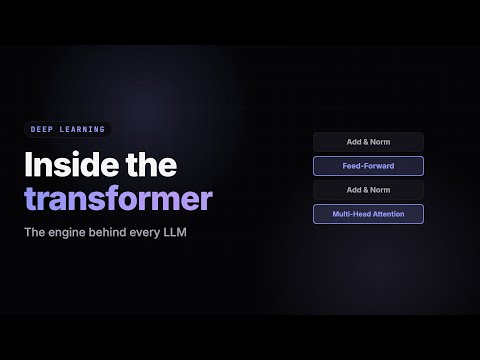
9:45 Inside the Transformer — The Engine Behind Every LLM
In 2017, a paper called "Attention Is All You Need" rewired the field of AI. The transformer it introduced is the engine inside every large language model — and once you see the one block it's built from, it stops being a black box.
 10:20
10:20 Context Engineering — Memory, Context Windows & MCP (the 2026 Skill)
Prompt engineering had its moment. In 2026 the skill that actually matters is context engineering — because a model's answer is only as good as what's in its context window, and deciding what goes in there is the real craft.
 9:57
9:57 How ChatGPT Was Really Built — Pretraining → Fine-Tuning → RLHF
"It was trained on the internet." True — but that's only stage one. A raw model trained on the whole internet, asked "what's the capital of France?", just autocompletes more questions. Turning that into ChatGPT takes three more stages — and here's each one.
 30:02
30:02 The DSA You Actually Need for AI & Data Science
Two programs. Same task. Same laptop. One finishes before you blink; the other would run for years. Nobody built a slower computer — they chose a slower idea.
 30:20
30:20 The SQL You Actually Need for AI & Data Science
You ask for "the top 3 products by revenue per region" — and a database hands back a tidy table without you writing a single loop or sort. That's SQL: you describe the answer, the engine figures out how. And there's one hidden idea that makes all of it finally click — the order the engine actually r
 29:08
29:08 Machine Learning, Demystified — The Complete Intuition (From Curve-Fitting to MLOps)
"The machine thinks for itself." It doesn't. Machine learning is curve-fitting — with discipline. And once you see the one loop underneath, every algorithm, metric, and buzzword falls into place. This is the complete intuition for machine learning, animated from the ground up: not a tour of librarie
 11:04
11:04 Unit Economics Explained: CAC, LTV, Payback & Margin
Revenue up 80% — and bleeding cash. A growing top line can completely hide a business that loses money per sale.
 10:16
10:16 Embeddings & Vector Search, Explained — The Map of Meaning
How does an AI know "happy" and "joyful" mean nearly the same thing, but "happy" and "stapler" don't? It turns every word into a point on a vast map of meaning, and looks at what's nearby. That's embeddings — and they quietly power search, recommendations, and RAG. This is the deep dive.
 9:58
9:58 How a Neural Network Actually Learns — Gradient Descent & Backprop
We say a neural network "learns" — but there's no understanding in there, no studying. Learning is something far more mechanical: a simple loop you could almost do by hand. Here it is, end to end.
 9:53
9:53 Multi-Agent Systems — When Many AI Agents Beat One (and When They Don't)
Give one AI agent a giant, multi-part job and it slowly loses the plot — its context overloads and it can't review its own work. The 2026 fix: stop using one generalist, and build a team. But more agents is NOT always better, and this video is honest about both sides.
 9:53
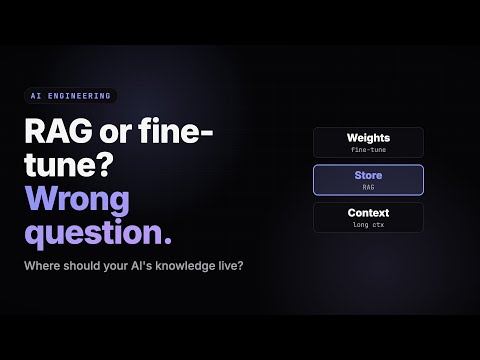
9:53 RAG vs Fine-Tuning vs Long Context — Where Should Your AI's Knowledge Live?
"Should we use RAG, or fine-tune the model?" It's the question every AI team fights about — and in 2026, it's the wrong question. Here's the mental model that actually tells you what to use, and when.
 9:57
9:57 Why "Thinking Longer" Makes AI Smarter — Reasoning Models & Test-Time Compute
Ask a normal AI a tricky puzzle and it answers instantly — and wrong. Ask a reasoning model and it pauses, "thinks" for a few seconds, and gets it right. Here's what that pause is actually doing — and why thinking longer makes AI smarter.
 30:56
30:56 The Python You Actually Need for AI & Data Science
Two lines of code add up a million numbers. One crawls; the other finishes ~100× faster — and the gap is the single most important idea in data-science Python. This is the Python you actually need for AI and data science: not a syntax tour, but the one mental shift that separates a beginner from a r
 10:58
10:58 How AI Image Generators Work: Diffusion Models Explained
AI doesn't paint your image stroke by stroke, and it doesn't copy one from a library. It starts from static and denoises.
 10:49
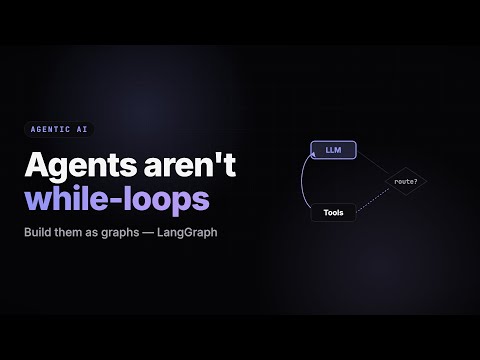
10:49 LangGraph Explained: Why an AI Agent Is a Graph, Not a Loop
Everyone pictures an AI agent as a while-loop. The moment you try to ship it, that shape cracks.
 26:32
26:32 Deep Learning & Generative AI, Intuitively — Single Neuron to ChatGPT (Transformers, LLMs & LLMOps)
"It works like the human brain." No — it's the same loop you already know, stacked deep, until the machine learns its own features. This is deep learning and generative AI built from a single neuron all the way up to ChatGPT — every concept animated so you can watch the machine think. By the end, th
 9:32
9:32 How AI Agents Actually Work (Chatbot vs Coworker)
You ask an AI to book a flight — and it actually books it. Searches, compares, fills in the details, done. That's not a chatbot; it's an agent. Here's exactly how they work.
 9:17
9:17 What Actually Happens When You Hit Enter on ChatGPT
You type a question, hit enter, and a fluent answer appears — as if it understood you. It didn't. Here's what actually happened in those few seconds.
 9:37
9:37 Why 99% Accuracy Can Be Useless — The ML Metrics That Fool You
Here's a fraud detector that's 99% accurate — and catches zero fraud. It just labels everything "not fraud," and since 99% of transactions aren't, it's right 99% of the time. Useless, and a straight-A student. This video dismantles that trap.
 10:26
10:26 The Only Math You Actually Need for Machine Learning
"I'd need a PhD in math" is the #1 reason people quit machine learning before they start. The truth: you need far less than you think — four intuitions, each with a simple visual meaning, cover the vast majority of it.
 11:05
11:05 A/B Testing Explained: Real Signal vs a Lucky Tuesday
Your conversion rate ticks up and the chart is green. You still know almost nothing — it could be pure chance.
 11:13
11:13 Feature Engineering: Why Better Features Beat Bigger Models
Garbage in, garbage out isn't a slogan — it's the law. Your features set the ceiling on how good a model can get.
 10:47
10:47 MCP Explained: The USB-C of AI (Model Context Protocol)
Connecting an agent to every tool by hand gives you an N×M tangle of brittle glue. There's a much better way.
 10:48
10:48 MLOps Explained: From a Notebook Model to Production
A model with great offline numbers that never reaches a real user is worth nothing — training is the easy 10%.
 10:30
10:30 Prompt Engineering: 5 Techniques That Actually Work
Same model, two prompts — one gives garbage, one gives exactly what you wanted. A prompt is an engineered input.
 10:50
10:50 Statistics for Machine Learning: One Idea, Not a Pile of Formulas
What scares people off statistics is the formulas. It's really one idea: reason honestly from a noisy glimpse of the world.