Variance, covariance & the covariance matrix
Variance measures how one feature spreads; covariance measures how two move together; correlation puts it on a clean −1 to 1 scale. Pack them into the covariance matrix and you have the object PCA, Gaussians, and Mahalanobis distance all run on.
What you'll learn
- Variance and standard deviation — the spread of a single feature
- Covariance — the sign and size of how two features move together
- Correlation — covariance normalized to a unit-free −1 to 1 scale
- The covariance matrix — variances on the diagonal, covariances off it
- Two traps: correlation isn't causation, and covariance only sees linear relationships
Before you start
The last lesson left a general question hanging: a Markov chain linked the state now to the state next, so how do any two random quantities relate? Here is the answer, and it has a number. You already know expected value — the centre of a distribution; the next two questions are how data spreads around that centre, and how two features move together. Spread and co-movement: that is the whole content of the covariance matrix, and it powers half of classical ML.
Variance: spread of one feature
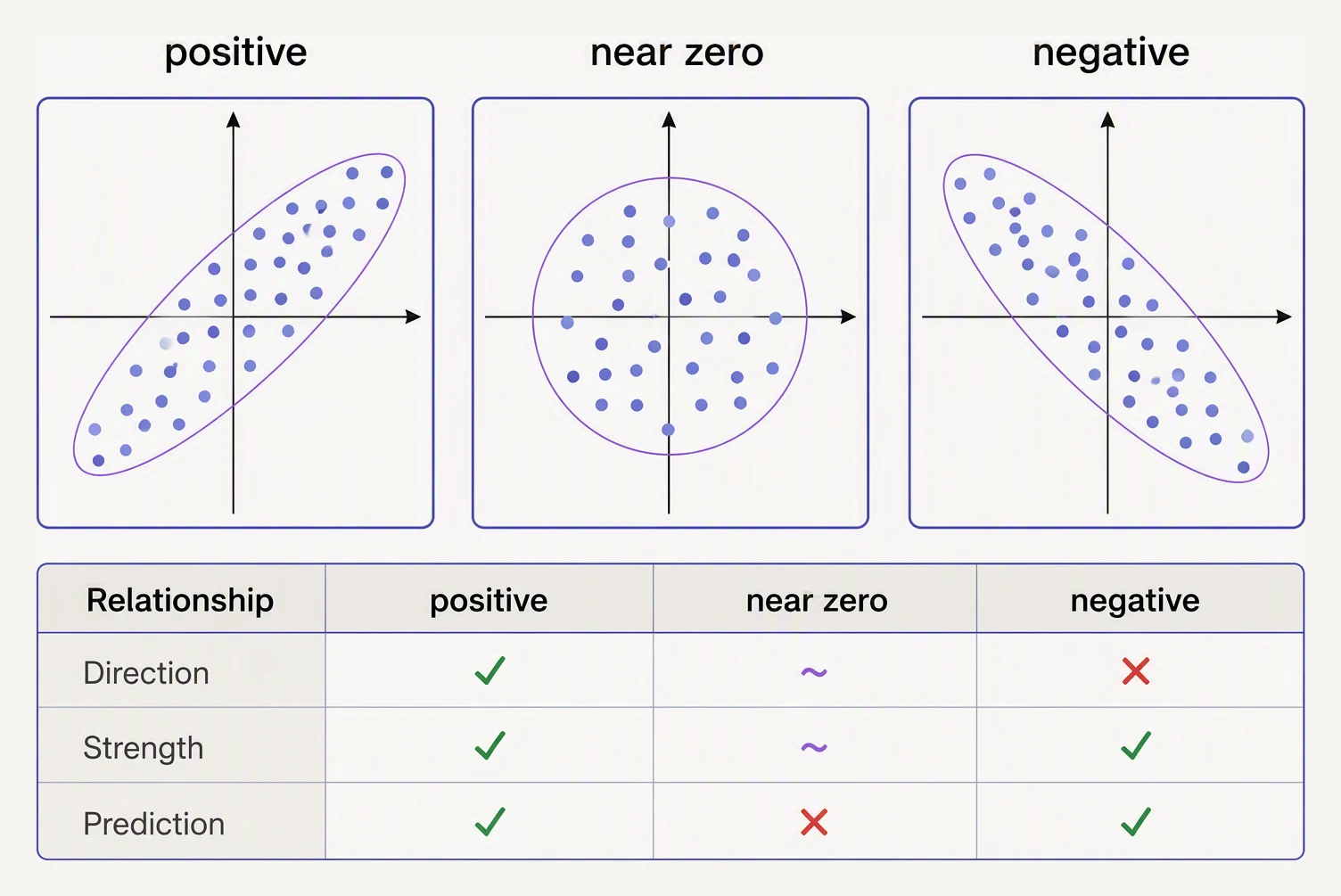
Covariance is the tilt of the cloud; the matrix stores every pairwise tilt.
Variance is the average squared distance from the mean:
Var(X) = E[(X − μ)²]Squaring keeps everything positive and punishes far-out points. Its square
root, the standard deviation σ, is back in the original units and is
what you usually report.
Covariance: do two features move together?
Covariance asks whether two features deviate from their means in sync:
Cov(X, Y) = E[(X − μₓ)(Y − μᵧ)]When X is above its mean and Y is above its mean, the product is
positive. Consistently positive → they rise together. Consistently negative
→ one rises as the other falls. Near zero → no linear relationship.
The catch: covariance’s units are units of X × units of Y — meaningless to
compare across pairs. So we normalize.
Correlation: covariance, made comparable
corr(X, Y) = Cov(X, Y) / (σₓ · σᵧ) ∈ [−1, 1]+1 is a perfect upward line, −1 a perfect downward line, 0 no linear
relationship. Now you can compare relationships across totally different
scales.
| 7.01 | 2.68 |
| 2.68 | 1.97 |
Diagonal = each feature's variance. Off-diagonal = how they move together. Normalize it by the spreads and you get correlation, always between −1 and 1.
The covariance matrix
For d features, collect every pairwise covariance into a d × d matrix
Σ: variances on the diagonal, covariances off it. It’s symmetric
(Cov(X,Y) = Cov(Y,X)) and positive semi-definite. The ellipse you just
rotated is Σ — its eigenvectors are the axes, its eigenvalues the spreads
along them.
import numpy as np

rng = np.random.default_rng(0)

height = rng.normal(170, 8, 500)
weight = 0.9 * height - 100 + rng.normal(0, 5, 500)   # correlated with height
noise  = rng.normal(0, 10, 500)                        # unrelated

X = np.vstack([height, weight, noise])   # 3 features x 500 samples
print("covariance matrix:\n", np.cov(X).round(1))
print("\ncorrelation matrix:\n", np.corrcoef(X).round(2))
# height-weight correlation is high; everything with 'noise' is ~0
covariance matrix:
[[ 65.9 59.5 2.1]
[ 59.5 75.8 0.7]
[ 2.1 0.7 102.2]]
correlation matrix:
[[1. 0.84 0.03]
[0.84 1. 0.01]
[0.03 0.01 1. ]]The correlation matrix reads the relationships off at a glance: height and weight sit at 0.84 (tightly linked, as built), while everything paired with noise is ~0.03 — no linear relationship at all. Note the raw covariance between height and weight (59.5) is impossible to interpret on its own; only after dividing by the two standard deviations does it become the clean, comparable 0.84.
Where this lives in ML
- PCA eigendecomposes
Σ— the directions of maximum spread are its top eigenvectors (you’ve seen this twice now). - The multivariate Gaussian is defined by a mean vector and
Σ. - Mahalanobis distance uses
Σ⁻¹to measure distance “in standard deviations,” accounting for correlated, differently-scaled features. - Multicollinearity is just high off-diagonal correlation — the rank problem from a statistical angle.
In one breath
Variance E[(X−μ)²] measures how one feature spreads (its root, the standard deviation σ, is back in original units). Covariance E[(X−μₓ)(Y−μᵧ)] measures whether two features deviate from their means in sync — positive means they rise together, negative means one rises as the other falls, near-zero means no linear link. Because covariance carries the product of both units, you normalise it to correlation Cov/(σₓσᵧ) ∈ [−1, 1], a unit-free strength of linear association. Stack all pairwise covariances into the symmetric, positive-semidefinite covariance matrix Σ (variances on the diagonal, covariances off it) — the same Σ that PCA eigendecomposes, that defines the multivariate Gaussian, and that Mahalanobis distance inverts. Two traps: correlation isn’t causation, and zero correlation rules out only linear dependence (a perfect parabola y = x² has correlation 0).
Practice
Quick check
A question to carry forward
Look at what the covariance matrix handed us: an ellipse. Σ said the cloud of points is wide here, narrow there, tilted just so — its eigenvectors the axes, its eigenvalues the spreads. But Σ is only a description of the shape; it is not yet a distribution. It cannot tell you how likely any particular point is, only how the cloud is stretched.
So here is the thread onward: what is the full probability distribution that wears this shape — centred at a mean vector μ, stretched and tilted by exactly this Σ? It is the multivariate Gaussian, the bell curve lifted into many dimensions and the one rich distribution we can actually compute with. What is its density, why does that same elliptical “Mahalanobis distance” sit in the exponent, and what closure magic — marginals, conditionals, and linear maps all staying Gaussian — makes it the backbone of Gaussian processes, Kalman filters, VAEs, and anomaly detection?
Practice this in an interview
All questionsCovariance measures the direction of the linear relationship between two variables and is expressed in the product of their units, making it scale-dependent and hard to interpret across different variable pairs. Correlation normalises covariance by both standard deviations to produce a dimensionless measure bounded between -1 and 1, enabling comparison across pairs.
Expected value is the probability-weighted center of a random variable, while variance is the expected squared distance from that center. Expected value is always linear, but variance needs scaling and covariance terms; independence is only required for the familiar variance-addition shortcut.
Variance is the average squared deviation from the mean; standard deviation is its square root and lives in the same units as the data. Variance is mathematically tractable — variances of independent variables add — while standard deviation is interpretable as a typical distance from the mean.
PCA centers data and finds orthogonal directions that maximize variance, usually through the covariance matrix's eigenvectors or an SVD, then projects observations onto the leading directions. Choose the component count using cumulative explained variance or reconstruction needs for compression, and cross-validated downstream performance for prediction; standardize first only when feature scales should contribute equally.