BentoML, Ray Serve, and friends — when FastAPI isn't enough
FastAPI is a great starting point. Past a certain scale you want automatic batching, multi-model hosting, versioned model storage, and autoscaling without hand-rolling them. Here's the landscape and when to graduate.
Written and reviewed by Shreyash Prashu Last reviewed
What you'll learn
- The five things FastAPI starts to do badly at scale
- The BentoML service abstraction and when you'd reach for it
- Ray Serve, KServe, Triton, Modal — what each is actually for
- The honest answer to 'should I migrate off FastAPI?'
Before you start
The last lesson left us with a service that worked but batched by hand — a separate endpoint, the caller deciding to chunk into 500s, one model per process scaled with more uvicorn workers.
We ended on the expensive truth it exposed: the single requests arriving on /predict are exactly the ones that would run 50× cheaper if grouped. The server could quietly group the ones landing within a few milliseconds and run them as one matrix — without the caller knowing.
We asked what it would take for the serving layer to do that batching for you. This lesson is the answer, and the honest boundaries of when you actually need it.
A FastAPI service running a sklearn model behind nginx is a totally respectable production setup. Plenty of companies have shipped exactly that and made millions. So the question isn’t “is FastAPI good enough?” — it usually is. The question is “what specific problem am I about to hand-roll, and is there a library that already solves it?”
There are five problems that FastAPI doesn’t solve on its own. Once two or more of them are on your roadmap, look at a dedicated serving framework.
When FastAPI starts to hurt
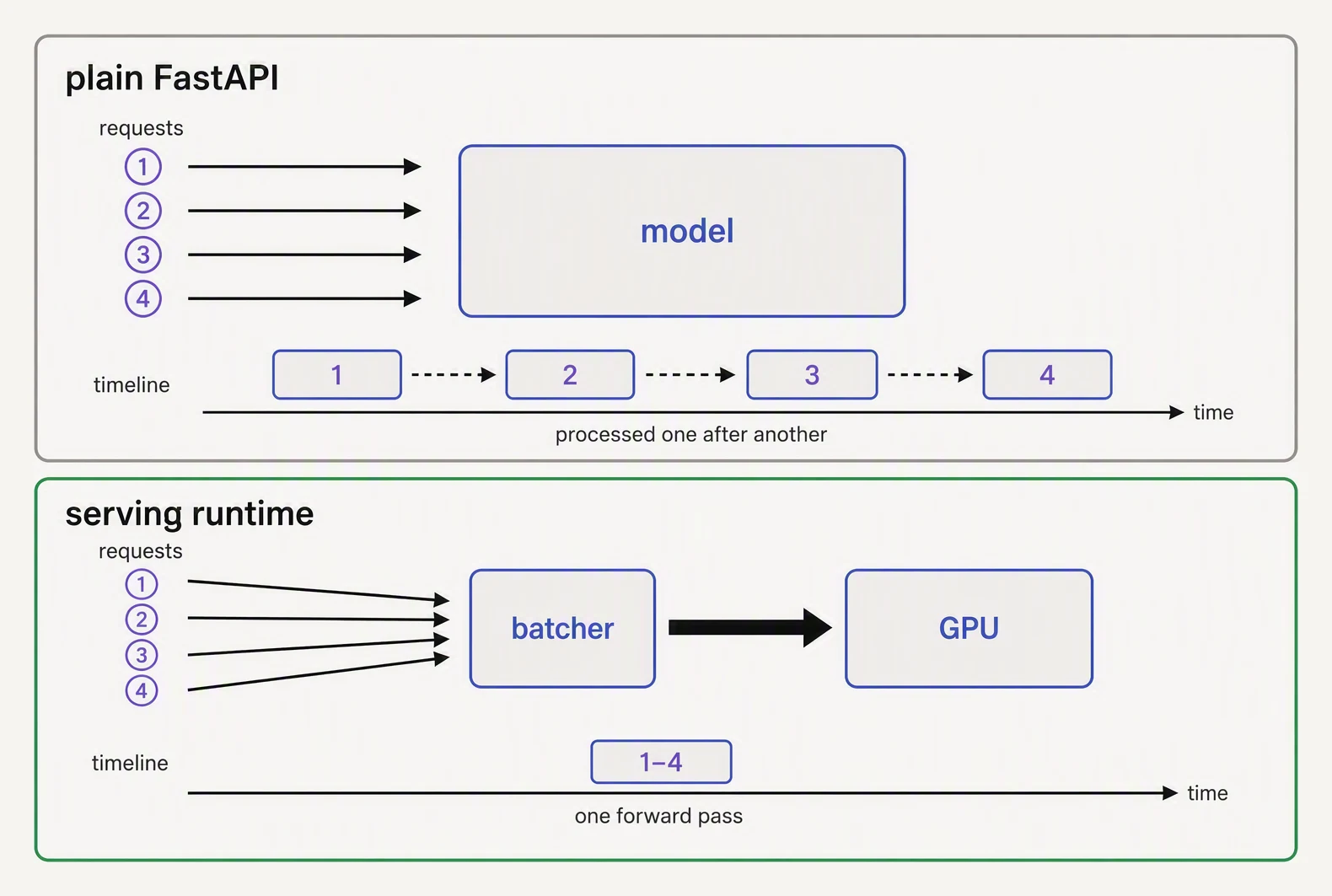
The gap is batching — one GPU, many requests, one forward pass.
| Problem | What you’d hand-roll without a framework |
|---|---|
| Adaptive micro-batching | A background queue that collects single-request inputs for ~5 ms and dispatches them as one batched call to the model |
| Multiple models in one process | Manual model loading + per-route dispatch logic, plus memory accounting |
| Model version routing | A registry lookup at request time, with per-version caching |
| Autoscaling tied to model load, not CPU | Custom metrics + an HPA configuration that watches the right thing |
| GPU-resource-aware scheduling | A queue that knows which workers have which model loaded |
Each of these is “doable” in FastAPI. None of them is trivial. If your service does inference at sub-100ms latency, has multiple models, or needs GPU efficiency, you’re going to write a small version of one of these frameworks. Better to use the real one.
BentoML — the service abstraction
BentoML’s pitch: a service is a class. Methods are endpoints. Decorators wire up batching, async, and model loading.
# service.py — BentoML 2.x API
import bentoml
import numpy as np

# 1. Decorate a class to declare it as a BentoML service.
@bentoml.service(
    resources={"cpu": "2"},
    traffic={"timeout": 10},
)
class ChurnService:
    # 2. Load the model once at class instantiation (startup), not per request.
    def __init__(self):
        self.model = bentoml.sklearn.load_model("churn_classifier:latest")

    # 3. Endpoint — type annotations drive validation and the OpenAPI schema.
    @bentoml.api
    def predict(self, input_arr: np.ndarray) -> np.ndarray:
        return self.model.predict_proba(input_arr)
That’s the minimum. Three things to notice:
@bentoml.serviceis the key abstraction. BentoML can run multiple replicas of this class, hand them GPUs, and batch incoming requests automatically — you describe the model, not the HTTP plumbing.- Adaptive batching for free. Add
@bentoml.api(batchable=True)and BentoML collects concurrent requests, batches them, and fans the responses back out. You don’t write a queue. You don’t tune it manually. It adapts to live traffic. - The bento itself.
bentoml buildpackages the code + the model artifact + the dependency lockfile into a “bento” — a versioned, hashable bundle.bentoml containerizeturns that into a Docker image.
The mental shift from FastAPI is: in FastAPI you wrote the HTTP layer and
treated the model as a Python object on app.state. In BentoML you
describe the model as a service class and let the framework handle the
HTTP, batching, and scaling.
Ray Serve — when the whole pipeline is a graph
Ray Serve sits on top of Ray (the distributed-compute framework). Its sweet spot is multi-step inference pipelines: a preprocessing service feeds an embedding service which feeds a ranker which feeds a business-rules layer. Each step is its own deployment, scaled independently, and connected with method calls that may cross machines.
# Ray Serve sketch
from ray import serve

@serve.deployment(num_replicas=4)
class Featurizer:
    def __call__(self, raw):
        return preprocess(raw)

@serve.deployment(num_replicas=2, ray_actor_options={"num_gpus": 1})
class Ranker:
    def __init__(self):
        self.model = load_model()
    def __call__(self, features):
        return self.model.predict(features)

@serve.deployment
class Pipeline:
    def __init__(self, featurizer, ranker):
        self.featurizer = featurizer
        self.ranker = ranker
    async def __call__(self, raw):
        features = await self.featurizer.remote(raw)
        return await self.ranker.remote(features)

# Compose
app = Pipeline.bind(Featurizer.bind(), Ranker.bind())
Ray Serve’s killer feature is heterogeneous replication: the featurizer needs CPUs and lots of replicas; the GPU ranker is expensive and you want exactly two of them. Hand-rolling that in FastAPI means K8s manifests + service-to-service calls + your own batching. In Ray Serve it’s the deployment decorator.
If you’re not running multi-stage inference, Ray Serve is overkill.
Other serious options
| Tool | When it’s the right answer |
|---|---|
| KServe | You’re all-in on Kubernetes and want a standard “InferenceService” CRD with rollouts, canary, scale-to-zero baked into the platform |
| Triton Inference Server (NVIDIA) | You’re serving GPU models (PyTorch, TensorRT, ONNX) and want the most production-hardened, lowest-latency GPU server — multi-framework, dynamic batching, model ensembles |
| Modal | You want a serverless platform that handles cold-start, scaling, GPU access without operating Kubernetes — pay-per-call ergonomics |
| vLLM / TGI | LLM-specific. Continuous batching, paged attention, the actual production stack for hosting open-weight LLMs |
| Seldon Core / MLServer | Heavily Kubernetes-native, with built-in explainability, drift, and outlier detection hooks if you live in an enterprise ML platform team |
The pattern across all of them: they pick a different axis of pain to solve. Triton solves “GPUs are expensive, batch them properly.” KServe solves “I want this to look like any other K8s workload.” Modal solves “I never want to touch K8s.” Pick the axis that hurts you most.
The honest “should I migrate?” framework
You’re on FastAPI. Migrate when two or more of these are true:
- Tail latency (p99) matters and you’re not micro-batching.
- You have more than ~3 models in one service.
- You have GPUs and you can’t keep them busy.
- Your traffic is bursty (10x peaks) and you autoscale on CPU only.
- You’re rewriting the same “load model from registry by name” code into every service.
If only one is true, you can probably keep FastAPI + write the one thing yourself. If three or more are true, you’ve already half-written a serving framework — switch to one that’s been hardened by other teams.
A runnable smoke test — same model, different wrappers
You can’t run BentoML’s HTTP server in the browser, but you can verify the model wrapper logic — turning a single inference into a batched one — works against the same sklearn artifact. This is the contract between your model code and any serving framework.
import time
import numpy as np

from sklearn.ensemble import RandomForestClassifier
from sklearn.datasets import make_classification

# 1) Train the same way any framework would consume.
X, y = make_classification(n_samples=2000, n_features=8, random_state=0)
model = RandomForestClassifier(n_estimators=80, random_state=0).fit(X, y)

# 2) A tiny 'runner' abstraction: take a list of single requests, batch them.
class BatchedRunner:
    """The pattern BentoML / Ray Serve apply automatically."""
    def __init__(self, model):
        self.model = model
    def predict_batch(self, rows):
        return self.model.predict(np.array(rows)).tolist()

requests = np.random.default_rng(0).random((200, 8)).tolist()   # 200 incoming requests
runner = BatchedRunner(model)

# Single-request mode (what hand-rolled FastAPI does row-by-row)
t0 = time.time()
out_single = [int(model.predict(np.array(r).reshape(1, -1))[0]) for r in requests]
single = (time.time() - t0) * 1000

# Batched mode (what BentoML/Ray Serve auto-batching does for you)
t0 = time.time()
out_batched = runner.predict_batch(requests)
batched = (time.time() - t0) * 1000

print("predictions identical:", out_single == out_batched)
print(f"single-request: {single:6.1f} ms")
print(f"batched      : {batched:6.1f} ms")
print(f"speedup      : {single/batched:.1f}x")
predictions identical: True
single-request: 289.7 ms
batched : 1.7 ms
speedup : 172.5xTwo numbers, two different kinds of truth. predictions identical: True
is the guaranteed part — the same model on the same inputs gives the
same answers whether you feed it one row at a time or all 200 at once.
A serving framework can batch behind your back with zero change in
correctness.
The timings are one machine’s numbers and will differ on yours — but the magnitude, a roughly hundred-fold gap between row-by-row and batched on a 200-row tree ensemble, is real and repeatable. That’s because it is an algorithmic win (vectorised matrix math plus amortised per-call overhead), not a fluke.
That gap is the entire economic case for a serving framework: it applies this batched code path automatically across concurrent HTTP requests, without you ever writing the queue.
In one breath
FastAPI is a respectable production setup, so you graduate to a dedicated serving framework not for prestige but when two or more specific pains appear:
- adaptive micro-batching
- several models in one process
- version routing
- model-load-aware autoscaling
- GPU scheduling
Adaptive batching is the single feature most worth migrating for (a 5–20× GPU throughput win that’s painful to hand-roll). BentoML makes a service a class and batches for free. Ray Serve shines for multi-stage pipelines with heterogeneous replicas.
Triton/KServe/Modal/vLLM each solve a different axis of pain. Pick the one matching the axis that actually hurts, and stay on FastAPI if only one trigger is true.
Practice
Before the quiz, apply the migration framework to two teams:
- Team A: one sklearn model, no GPU, ~10 requests per second.
- Team B: a GPU transformer with bursty 10× traffic peaks, three model versions live at once, and a p99 SLA.
For each, say whether they should stay on FastAPI or migrate, and which one trigger decides it.
Then the batching insight: the demo showed batched inference is identical in output but ~100× faster. Why can’t you just always call the batch endpoint, and what does the framework do that a hand-written batch endpoint cannot?
Quick check
A question to carry forward
Notice the unexamined assumption running under this whole lesson — and the last one. Every framework here, every micro-batching queue and GPU scheduler, exists to make a request-time prediction faster: a user is waiting, milliseconds matter, batch the bursts. We have spent two lessons optimizing the live path without once asking whether the prediction needs to be live at all.
And for most predictions, it doesn’t. A churn score, a lead ranking, a recommendation list — none of these change in the instant a user loads the page; they could have been computed at 3 a.m. over the whole table and simply looked up.
So the question to carry forward steps back from “how do I serve this request fast?” to the cheaper, prior one: does this prediction need to happen in real time at all? Or can it be precomputed in a batch job and served from a lookup? That choice — batch versus real-time inference — is one of the highest-leverage cost decisions in MLOps, and it is the next lesson.
Practice this in an interview
All questionsWork top-down: start at the model layer with quantization, distillation, or routing cheaper models for easy requests, since model choices drive every downstream cost. Then optimize the runtime with batching, caching, and techniques like prompt caching for LLMs, and finally match infrastructure to the load using autoscaling on queue depth and spot or batch capacity. Track cost per token or per prediction alongside latency percentiles and accuracy so optimizations never silently degrade quality.
GPUs execute tensor operations efficiently only when the batch dimension is large enough to saturate all CUDA cores. Dynamic batching collects individual requests arriving within a short window and fuses them into a single GPU call, dramatically improving throughput and cost efficiency without sacrificing per-request latency beyond the configured wait threshold.
gRPC uses HTTP/2 and Protocol Buffers to deliver lower latency, strongly typed contracts, and built-in streaming, making it the better choice for high-throughput internal model services. REST remains the standard for public-facing APIs where broad client compatibility and human-readable payloads matter more than raw performance.
Autoscale ML inference on a leading workload signal such as per-pod queue wait or backlog, with GPU or model-specific throughput as supporting signals; CPU alone misses accelerator saturation. Kubernetes HPA supports custom or external metrics, while strict online SLAs usually require warm replicas and scale-to-zero only for workloads that tolerate measured cold starts.