Feature engineering & encoding
On tabular data the model is a commodity — the features are the edge. Encoding categoricals, scaling numerics, interactions and aggregations, all wired through a leak-proof Pipeline.
What you'll learn
- How to encode categoricals — one-hot, ordinal, and target encoding (and when each fits)
- When scaling matters (linear/distance models) and when it doesn't (trees)
- Wiring transforms through a ColumnTransformer + Pipeline so nothing leaks
Before you start
Here’s the open secret of tabular machine learning: the algorithm is rarely what wins. Swap XGBoost for LightGBM and your score barely moves. But change how you represent the data — how you encode a category, whether you scale, what features you build — and the score can jump. Survey the people who actually win Kaggle and the refrain is the same: feature engineering, not algorithm choice, is what separates the top tabular solutions. The model is a commodity. The features are the edge.
Encoding categoricals — the daily decision
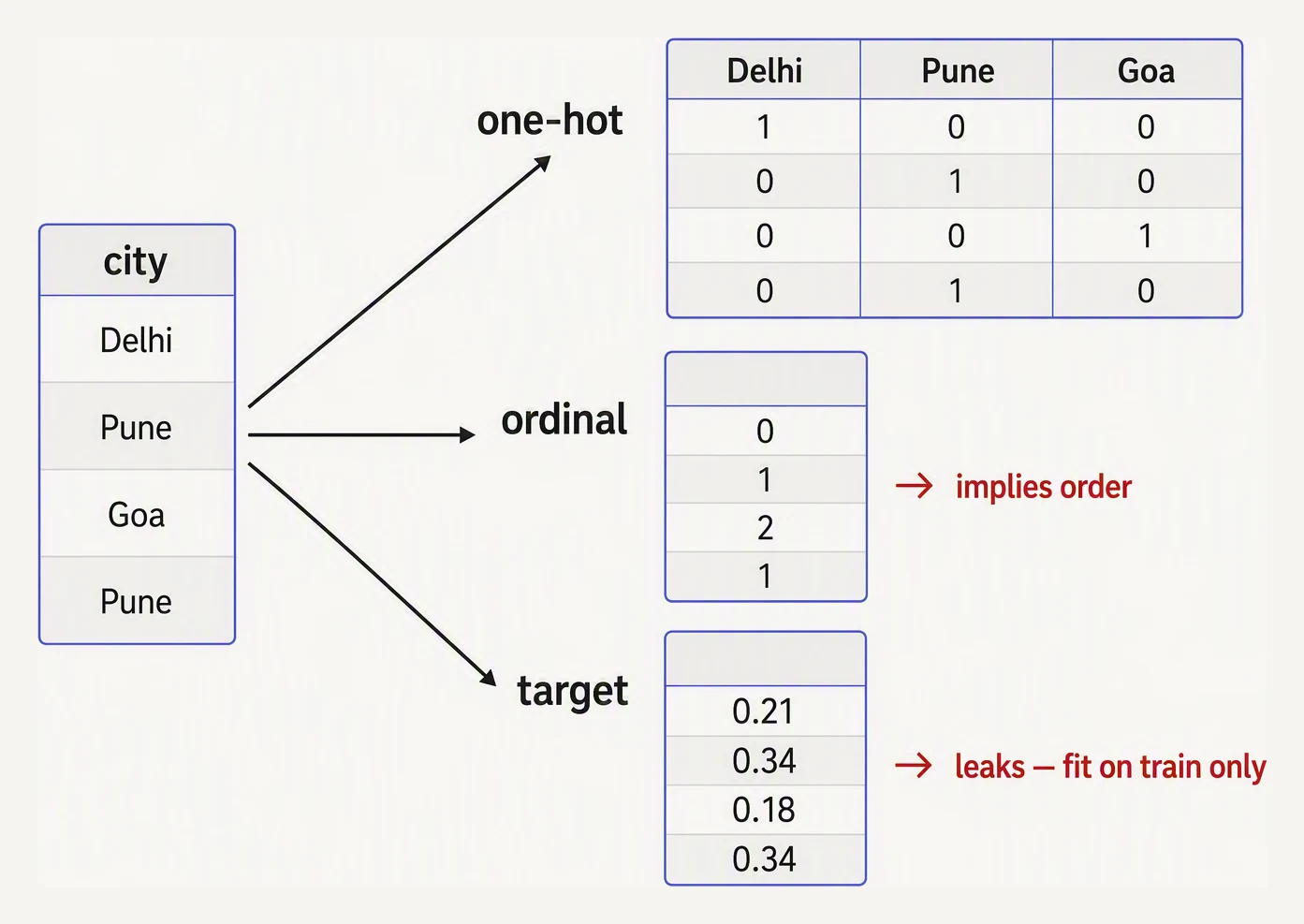
Three encodings, three different assumptions about what the categories mean.
Models eat numbers, but data is full of categories (city, product, device).
Three ways to turn a category into numbers, and the right one depends on
cardinality and the model:
- One-hot — one 0/1 column per category. Perfect for low cardinality
(
device ∈ {ios, android, web}). For high cardinality it explodes the feature count into a sparse mess. - Ordinal — map each category to an integer. Only correct when the category
is genuinely ordered (
size ∈ {S, M, L}). For unordered categories it invents a false ranking a linear model takes literally. - Target encoding — replace each category with the mean target for that
category. Compact and powerful for high cardinality (
zip_code,user_id) — but it peeks at the label, so it must be fit inside cross-validation or it leaks.
Here is the same city column under all three encodings — watch how differently each
one hands the category to a model (target y = [1, 0, 1, 0]):
| row | city | one-hot → (Paris, Tokyo, Cairo) | ordinal | target = mean of y |
|---|---|---|---|---|
| 1 | Paris | 1, 0, 0 | 0 | 1.00 |
| 2 | Tokyo | 0, 1, 0 | 1 | 0.00 |
| 3 | Paris | 1, 0, 0 | 0 | 1.00 |
| 4 | Cairo | 0, 0, 1 | 2 | 0.00 |
One-hot keeps categories independent — no false order, but one column each.
Ordinal is a single column, yet it tells a linear model Cairo (2) > Paris (0), a
ranking that isn’t real. Target is one column carrying real signal — and exactly
why it must be cross-fit: those 1.00 / 0.00 values were computed from the very
labels you are trying to predict, so fitting them on data a fold will later be tested
on leaks the answer.
Scaling numerics — matters, except when it doesn’t
Should you standardize features to mean-0, variance-1? It depends entirely on the model:
- Linear models, SVMs, k-NN, neural nets — yes. They compare feature
magnitudes directly, so an unscaled
income(tens of thousands) drowns outage(tens). Standardize or min-max scale. - Trees and tree ensembles (random forest, XGBoost) — no effect. A tree
splits on a threshold (
income > 50000?), so multiplying a feature by 1000 changes nothing. Don’t bother.
The right way: ColumnTransformer + Pipeline
The professional pattern applies different transforms to different columns and
bundles everything into one Pipeline — so the exact same transformation is
re-fit inside each CV fold and re-applied at inference. This is what makes feature
engineering leak-proof.
import numpy as np, pandas as pd

from sklearn.compose import ColumnTransformer
from sklearn.preprocessing import OneHotEncoder, StandardScaler
from sklearn.pipeline import Pipeline
from sklearn.linear_model import LogisticRegression
from sklearn.model_selection import cross_val_score

rng = np.random.default_rng(0); n = 600
df = pd.DataFrame({
    "device": rng.choice(["ios","android","web"], n),
    "age":    rng.integers(18, 70, n),
    "income": rng.gamma(2, 30000, n).round(0),
})
df["buy"] = ((df.device=="ios") + (df.age<35) + (df.income>70000) + rng.normal(0,0.8,n) > 1.2).astype(int)
X, y = df[["device","age","income"]], df["buy"]

# Different transforms per column, all inside ONE pipeline:
pre = ColumnTransformer([
    ("cat", OneHotEncoder(handle_unknown="ignore"), ["device"]),
    ("num", StandardScaler(), ["age", "income"]),   # scaling helps the linear model
])
pipe = Pipeline([("pre", pre), ("clf", LogisticRegression(max_iter=500))])

# The transforms are re-fit inside each fold — no leakage.
scores = cross_val_score(pipe, X, y, cv=5, scoring="roc_auc")
print(f"5-fold AUC: {scores.mean():.3f} +/- {scores.std():.3f}")Beyond encoding — the features that actually win
Encoding gets the data in; these build the edge:
- Aggregations (groupby). “Average spend per user,” “transactions in the last 7 days.” Group-level statistics are the single most powerful tabular feature family — they inject context a single row can’t see.
- Interactions.
debt / income,price × quantity. Ratios and products capture relationships the model would otherwise have to discover. - Datetime features. From a timestamp, extract day-of-week, hour, is-weekend, days-since-event. A raw timestamp is nearly useless; its parts are gold.
- Binning & transforms. Bucketing a skewed feature, or
log(income), can linearize a relationship for linear models.
In one breath
- On tabular data the algorithm is a commodity; the features are the edge — how you represent the data moves the score more than the model choice.
- Encode categoricals by cardinality + model: one-hot (low cardinality), ordinal (only genuinely ordered categories), target encoding (high cardinality — compact, but peeks at the label, so it must be cross-fit).
- Scale numerics for magnitude-comparing models (linear, SVM, k-NN, neural nets); skip it for trees, whose threshold splits are scale-invariant.
- Wire every transform through a ColumnTransformer + Pipeline so encoders/scalers re-fit inside each CV fold — fitting on the full data before CV leaks and inflates the score (target encoding is the worst offender).
- The features that actually win: aggregations (groupby), interactions (ratios/products), datetime parts, and binning/log transforms — and for modern trees, prefer those over heavy encoding.
Quick check
Quick check
zip_code feature with 5,000 distinct values, feeding a logistic regression. Best encoding?Next
Now that your features are honest, you need to read whether the model is underfitting or overfitting them — bias–variance & learning curves — and validate it without leaking, in train/val/test & CV.
Practice this in an interview
All questionsFeature engineering is creating, transforming, or selecting input variables so a model can capture patterns more easily. Common techniques include scaling, encoding categoricals, binning, interaction and ratio features, date/time decomposition, and domain-derived aggregates. It often matters more than the choice of algorithm because models can only learn from the signal present in their inputs.
Scale features for distance-based models, PCA, neural networks, and regularized linear or logistic models because magnitudes affect geometry, optimization, or coefficient penalties. Tree-based models generally do not need scaling because threshold splits preserve feature order; ordinary unregularized linear models may work without it, but scaling often improves numerical conditioning.
Feature leakage occurs when information from the test set or from the future leaks into training features, making a model appear more accurate than it will be in production. It arises from fitting preprocessing steps on the full dataset, using post-event information as a predictor, or computing aggregates across train-test boundaries. Prevention requires strict pipeline discipline: all stateful transformations must be fit only on training data.
One-hot encoding becomes impractical when a categorical feature has hundreds or thousands of unique levels, producing a sparse matrix that slows training and causes overfitting on rare categories. Better approaches include target encoding with smoothing, frequency encoding, hashing, learned embeddings, or grouping rare categories into an 'Other' bucket, each with different tradeoffs on leakage risk and information retention.