Decision Trees — Making Choices Under Uncertainty
Launch nationally, run a pilot, or skip it entirely? Decision trees give you a structured way to compare options when the future is uncertain — and fold-back arithmetic tells you which branch wins.
Written and reviewed by Shreyash Prashu Last reviewed
What you'll learn
- What decision nodes (squares) and chance nodes (circles) mean in a decision tree
- How fold-back works: evaluate right-to-left, pick the highest EV at every decision node
- Why a lower-EV pilot can still be the smarter choice — value of information
- How a single shaky probability estimate can flip the entire recommendation
Before you start
Expected value scored a single bet — take the campaign or don’t. But the last lesson ended on a richer kind of choice: launch now, or pilot first and decide later based on what you learn. That’s a decision feeding a chance event feeding another decision. This lesson is the tool for exactly that shape.
Your market research says there’s a 45% chance the market is good. A full national launch could return $900k — or cost you $300k if it flops. A cautious pilot caps your downside at $50k but also caps your upside at $250k. Doing nothing costs nothing and earns nothing.
These three options feel incomparable — different upside, different downside, different probabilities. A decision tree is the tool that makes them comparable.
What a decision tree is
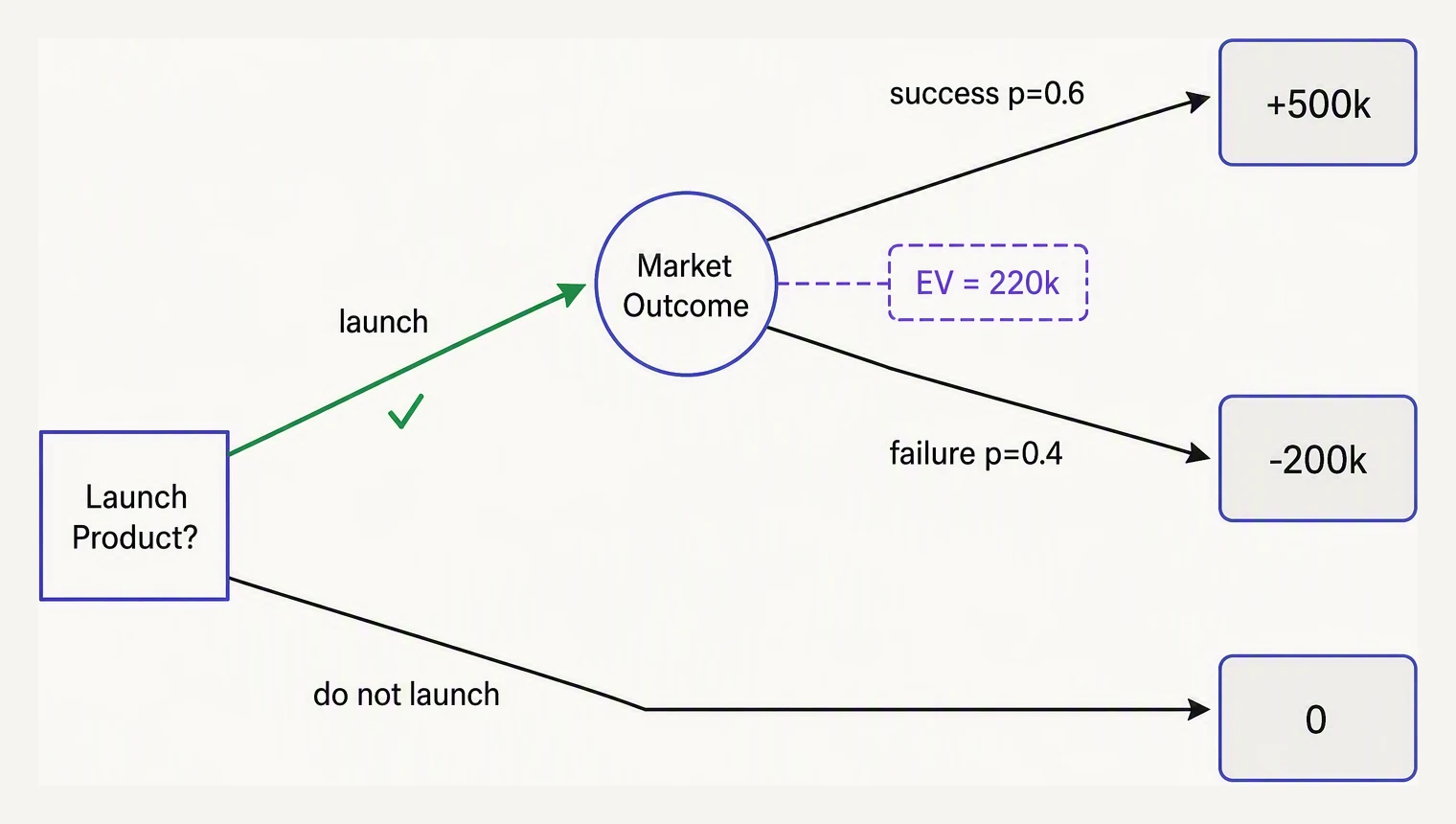
Roll the values backwards from the leaves and the choice makes itself.
A decision tree lays your problem out left to right like a branching path. Two kinds of nodes (junction points) do all the work:
- A square node is a decision node — a fork where you pick which branch to take (launch, pilot, skip).
- A circle node is a chance node — a fork where the market picks, and each branch carries a probability (good market, bad market).
At the far right of every branch sits a payoff — the dollar outcome if the path up to that point actually happened.
The art is drawing the tree accurately. The math is called fold-back.
Fold-back: evaluate right to left
Fold-back (also called roll-back) is the procedure for collapsing the tree into a single recommended action. You work from the tips back toward the root:
- At every chance node, compute the expected value —
probability × payoffsummed across all branches. (Expected value, introduced in the previous lesson, is the probability-weighted average outcome.) - At every decision node, keep only the branch with the highest EV and discard the others.
- The EV that survives at the root is the value of the whole decision — and the surviving path is your recommendation.
Let’s do it with real numbers.
The launch decision — by hand
Here are the payoffs (in $k for readability):
| Path | Probability | Payoff |
|---|---|---|
| Go national, market good | 0.45 | +$900 |
| Go national, market bad | 0.55 | −$300 |
| Run a pilot, market good | 0.45 | +$250 |
| Run a pilot, market bad | 0.55 | −$50 |
| Don’t launch | 1.00 | $0 |
Fold back the two chance nodes first:
EV(Go national) = 0.45 × $900 + 0.55 × (−$300)
               = $405 − $165
               = $240

EV(Run a pilot) = 0.45 × $250 + 0.55 × (−$50)
               = $112.50 − $27.50
               = $85

EV(Don't launch) = $0
At the decision node you compare $240, $85, and $0. Go national wins — at 45% odds of a good market, the expected payoff of $240 beats the pilot ($85) and doing nothing ($0).
Try it: drag the probability and watch the recommendation flip
Three choices, one uncertain market
Each option's value is its expected value: every outcome's payoff weighted by its probability. Pick the highest.
The widget shows the exact tree above. Hit Go national at 45% — it highlights green at $240. Now drag P(market is good) down toward 20%. Watch the recommendation shift. At a low enough probability the national launch EV turns negative and the pilot (or even doing nothing) becomes the smart call. The tree doesn’t change; only one input changes — and the whole recommendation flips.
That is both the power and the risk of a decision tree.
Why a pilot can beat national even with a lower EV
Notice that the pilot EV ($85) is well below the national EV ($240) at 45% odds. Yet there are two reasons a rational manager might still choose the pilot:
Downside protection. The worst case nationally is −$300. The worst case for a pilot is −$50. If your company cannot absorb a $300k loss — say, it would force layoffs or kill another project — the pilot’s capped downside has real value that the EV number doesn’t capture.
Value of information. A pilot lets you learn before committing fully. Running a small test and observing real customer behaviour updates your probability estimate. If the pilot goes well you can then launch nationally with much higher confidence. The technical term is value of information — sometimes the smart move is the option that lets you learn cheaply before betting big, even if its standalone EV is lower.
Where trees go wrong
The practical implication: spend your energy getting the probabilities right, not just the payoffs. A $900k upside is irrelevant if the probability attached to it is fantasy.
Decision trees in practice
Decision trees show up wherever structured choices meet uncertain outcomes: capital allocation, product roadmaps, hiring a senior role vs. promoting internally, entering a new market. The format scales — you can nest chance nodes inside chance nodes, add more decision points later in the tree (should we double down if the pilot succeeds?), and attach costs to the act of gathering information itself.
The core discipline is always the same: draw the tree honestly, assign probabilities carefully, fold back from right to left, and let the EV guide — not override — your judgment.
In one breath
A decision tree lays a choice out left to right with two kinds of node: squares (decision nodes, where you choose) and circles (chance nodes, where the world chooses, each branch carrying a probability). Solve it by fold-back, right to left: average the branches at each chance node into an expected value, then at each decision node keep only the highest-EV branch — the number left at the root is the decision’s value and the surviving path is your recommendation. Here Go National ($240) beats Pilot ($85) and Skip ($0) at 45% odds. Two caveats keep it honest: a lower-EV option can still win on downside protection or value of information (a pilot lets you learn cheaply before betting big), and the whole tree is only as trustworthy as its probabilities — never just chase the biggest payoff.
Practice
Quick check
A question to carry forward
Go back to the moment in the explorer where dragging one slider — P(market is good) — flipped the entire recommendation from “go national” to “pilot.” That should make you slightly uneasy. The tree didn’t change; a single estimate did, and the answer reversed. And that estimate, 45%, was itself a guess.
So the question to carry forward is: when the recommendation hinges on a number you’re not sure of, how unsure can you afford to be? Which assumption, if it’s wrong, actually changes your decision — and how far does it have to move before it does? The next lesson is sensitivity analysis: the disciplined way to stress-test every shaky input, find the one or two that the decision truly pivots on, and stop worrying about the rest.
Practice this in an interview
All questionsAt each node, a decision tree evaluates eligible feature and threshold pairs, measures the weighted impurity left after the split, and chooses the pair with the largest impurity reduction. It repeats this greedy process on each child until a stopping rule or lack of useful split ends the branch.
Pruning regularizes a decision tree by preventing or removing branches that fit noise rather than a repeatable pattern. Pre-pruning stops growth with constraints such as maximum depth or minimum samples per leaf; post-pruning grows a larger tree and selects a smaller subtree, often with cross-validated cost-complexity penalty.
The optimal threshold depends on the business cost of false positives versus false negatives, not on defaulting to 0.5. You choose it by plotting the PR or ROC curve on a held-out set, computing the metric that captures your cost function (e.g., F-beta, revenue, expected cost) at each threshold, and selecting the point that maximises it. Threshold tuning is free and should always precede resampling or model changes.
Gini impurity uses squared class probabilities, while entropy uses logarithms to measure uncertainty. Both score weighted child purity and usually select similar splits; Gini is a little cheaper, but the data, class imbalance, and tree regularization matter more than the choice.