Break-Even Analysis
How many units must you sell each month just to stop losing money? Break-even analysis gives every new product, shop, or subscription the answer — and shows exactly what moves it.
Written and reviewed by Shreyash Prashu Last reviewed
What you'll learn
- Fixed costs vs variable costs — and why the distinction drives everything
- Contribution margin: what each sale actually contributes toward covering your fixed costs
- The break-even formula and how to read the cost-revenue chart
- Margin of safety — how far you are above break-even
- Why baking fixed costs into the per-unit cost gives the wrong answer
Before you start
The last lesson left us with a P&L that was barely profitable and the nagging question of where the tipping point sits — the volume at which loss flips to profit. This lesson computes that point exactly. We’ll trade the year-end snapshot for a candle brand we can run forward unit by unit.
Every new product, shop, or subscription has to answer one question before anything else: how many do we have to sell each month just to stop losing money? That is the break-even question. Get the answer wrong — or skip the exercise — and you can be busy, even seemingly successful, while quietly burning cash every single month.
Two kinds of cost
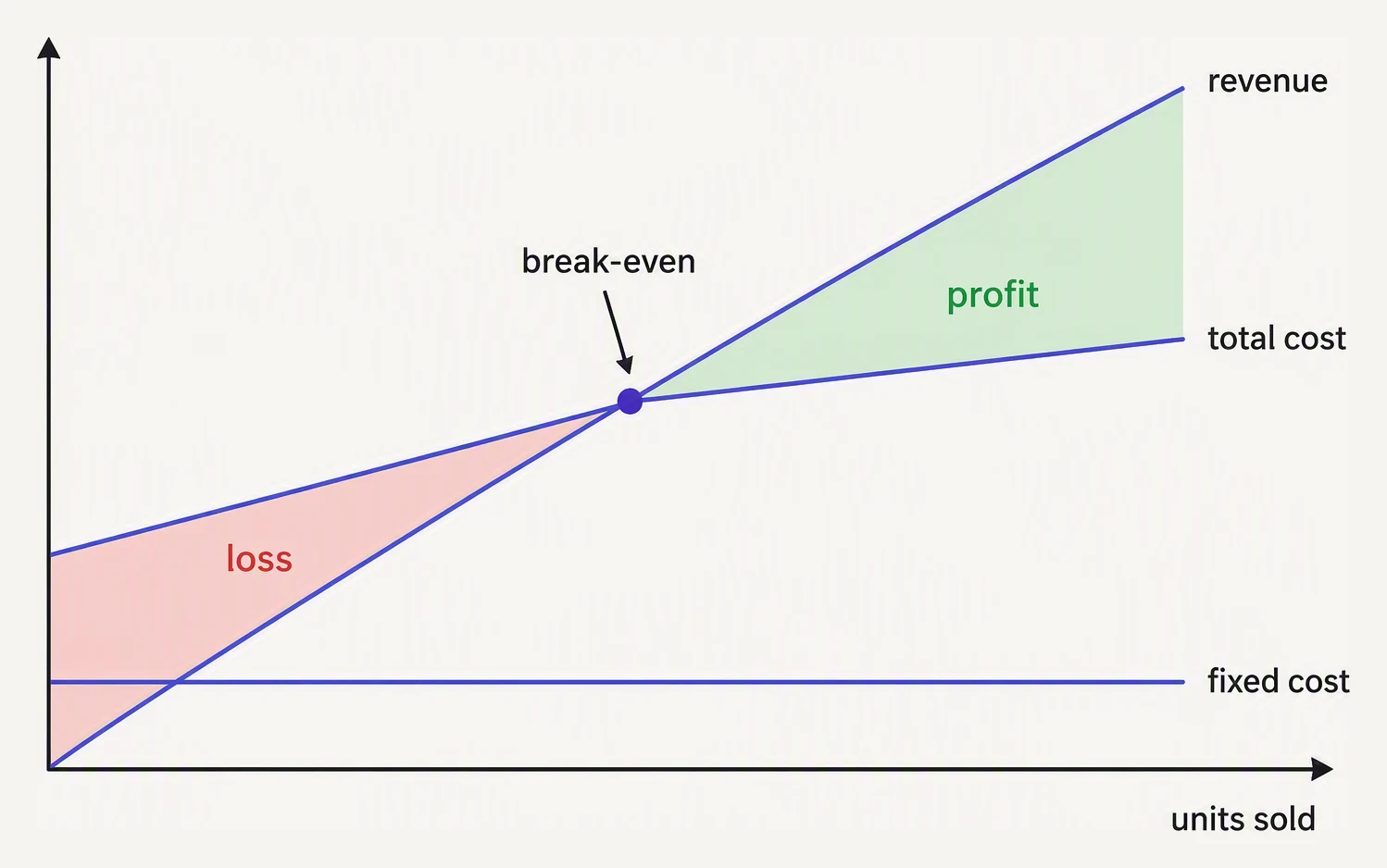
Below the crossing you are buying customers. Above it you are earning.
Before the formula, you need two vocabulary words, because break-even lives on the difference between them.
Fixed costs are expenses that stay the same every month regardless of how much you produce or sell. Rent, salaries, software subscriptions, loan repayments — these bills arrive whether you sell one unit or one thousand. In our candle example the studio lease plus the helper’s wages totals $6,000 per month, fixed.
Variable costs are expenses that rise in direct proportion to the number of units you sell. Each extra candle requires extra wax, wicks, and packaging. In our example those materials cost $20 per candle. Make zero candles and you spend $0 on materials; make 100 and you spend $2,000.
The split matters because fixed costs do not go away if sales are slow — they become a debt you must work off. Variable costs, by contrast, you only incur when you actually produce.
Contribution margin — the engine
Now here is the key concept: contribution margin per unit (shortened to contribution margin) is what each sale contributes toward covering the fixed costs, after paying its own variable cost.
Contribution margin = price per unit minus variable cost per unit
For the candle brand:
- Price per candle: $50
- Variable cost per candle: $20
- Contribution margin = $50 minus $20 = $30 per candle
Every candle sold chips $30 off the fixed-cost pile. The fixed pile is $6,000. So the business needs to chip away at $6,000, $30 at a time.
The break-even formula
Break-even units = fixed costs divided by contribution margin per unit
break-even units = fixed costs ÷ contribution margin
                 = $6,000 ÷ $30
                 = 200 units per month
At 200 candles sold, total revenue equals total cost and profit is exactly zero — you are neither making money nor losing it. That is the break-even point.
Break-even revenue (the dollar figure instead of the unit count) is simply:
break-even revenue = 200 units × $50 = $10,000 per monthTry it — drag the sliders
The explorer below draws two lines on a chart: the revenue line (price times units) and the total-cost line (fixed costs plus variable cost times units). Where those two lines cross is the break-even point. The defaults match the candle example above.
Where does revenue finally cover cost?
Try raising the price slider — notice the revenue line rotates upward and break-even moves left (fewer units needed). Try increasing the variable cost — the cost line steepens and break-even moves right. Cut the fixed cost — the cost line drops and break-even moves left. Each slider change updates contribution margin, break-even units, and break-even revenue instantly.
What happens on either side of break-even
Below break-even, every unit you sell reduces your loss but does not eliminate it. You are using each unit’s $30 contribution margin to pay down the fixed-cost pile, but the pile is not yet gone.
At break-even, the pile is exactly gone. Profit = $0.
Above break-even, the fixed costs are fully covered. Every additional unit’s full $30 contribution margin flows straight to profit. At 201 candles, profit is $30. At 300 candles, profit is (300 minus 200) times $30 = $3,000. The business is now leveraged on the upside by its fixed costs.
This is why high-fixed-cost businesses (airlines, streaming platforms, software companies) tend to have dramatic profits once they cross break-even — and dramatic losses when volume falls below it.
Margin of safety — your cushion
Once you know break-even, you can measure margin of safety: how far your current or expected sales are above break-even, expressed in units or as a percentage of sales.
If the candle brand currently sells 260 candles per month:
- Margin of safety = 260 minus 200 = 60 units, or 60 divided by 260 = 23%
That 23% is a cushion. Sales can fall 23% before you start losing money. A thin margin of safety means you are operating close to the edge; a large one gives you room to absorb a slow month or a price discount.
The one number you must not confuse
Edge case: negative contribution margin
If the price you charge is less than or equal to the variable cost per unit, the contribution margin is zero or negative. Every unit you sell either breaks even on variable costs alone (and you never cover fixed costs) or actively loses money. No volume of sales can save you — there is no break-even point. The explorer widget shows this: drag variable cost above the price and watch the lines never cross.
In one breath
Break-even answers “how many units just to stop losing money?” Split costs in two: fixed costs (rent, salaries — $6,000/month, owed at any volume) and variable costs (materials — $20/candle, only when you produce). The engine is contribution margin = price − variable cost = $50 − $20 = $30, what each sale chips off the fixed pile. Break-even units = fixed ÷ contribution margin = $6,000 ÷ $30 = 200 candles; below it every sale shrinks your loss, above it every sale’s full $30 is profit — which is why high-fixed-cost businesses swing hard both ways. Margin of safety is how far current sales sit above break-even. Two traps: never fold fixed costs into the per-unit cost (they belong in the formula’s numerator once), and if price ≤ variable cost the contribution margin vanishes and no volume ever breaks even.
Practice
Quick check
A question to carry forward
Notice the quiet assumption we just made: each candle was a one-shot sale. Sell it, pocket the $30, move on. But most modern businesses don’t work that way — a subscriber, a repeat buyer, a loyalty member comes back month after month. And acquiring that customer in the first place wasn’t free: you spent on ads, sales calls, a discount to pull them in.
So the question to carry forward is: what does break-even look like not for a single unit, but for a whole customer relationship? The next lesson is unit economics — CAC (what you pay to acquire one customer) versus LTV (the profit that customer delivers across their entire lifetime). It’s the same contribution-margin logic you just learned, stretched across months instead of a single sale — and it’s the number that decides whether spending to grow makes you rich or bankrupts you.
Practice this in an interview
All questionsRun until you have reached the pre-calculated sample size — which should include at least one full weekly cycle to average out day-of-week effects. Stopping early because results look good, or extending because they do not, both inflate error rates.
The default 0.5 threshold optimises for balanced accuracy but is rarely the right choice for business objectives. The correct threshold is found by translating the business cost of false positives and false negatives into a cost matrix, then sweeping the threshold on a held-out set to find the point that minimises expected cost or maximises expected profit. Operational constraints — such as review-team capacity — further bound the feasible region.
Sample size, power, and MDE form a three-way trade-off: fix any two and the third is determined. You choose the MDE based on business materiality, then solve for the sample size that delivers 80–90 % power at alpha = 0.05.
Offline metrics often don't predict business impact, so you run a controlled online experiment: split live traffic between the current champion and the new challenger and compare a pre-registered business metric with a statistical significance test. You size the test for adequate power, watch guardrail metrics like latency and errors, and only ship if the lift is statistically and practically significant. Variance-reduction techniques like CUPED let you reach significance faster.