Unit Economics
We pay $280 to acquire a customer who pays $40 a month — are we making money or lighting it on fire? Unit economics answers whether ONE customer is profitable, which decides whether growth helps or kills you.
Written and reviewed by Shreyash Prashu Last reviewed
What you'll learn
- What unit economics means and why it controls whether scaling helps or hurts
- ARPU, gross margin, churn — and how they combine into LTV
- CAC, payback period, and the 3× LTV:CAC rule of thumb
- Why computing LTV on revenue (not gross profit) is the most common — and dangerous — mistake
Before you start
Break-even asked how many units you must sell to cover this month’s fixed costs. The last lesson treated each sale as a one-shot.
This lesson stretches the very same contribution-margin logic across a whole customer relationship — one that costs money to start and then pays back, month after month, until it ends.
Revenue growing 40% a year looks exciting until you ask: does each individual customer actually make us money? A business can scale rapidly while losing more on every customer it adds. Unit economics is the lens that catches this before it’s fatal.
Unit economics — the revenue and cost associated with a single unit of the business (here, one customer) — tells you whether your fundamental model works. If the unit is profitable, growth is an accelerant. If it isn’t, growth is gasoline on a fire.
The four numbers you need
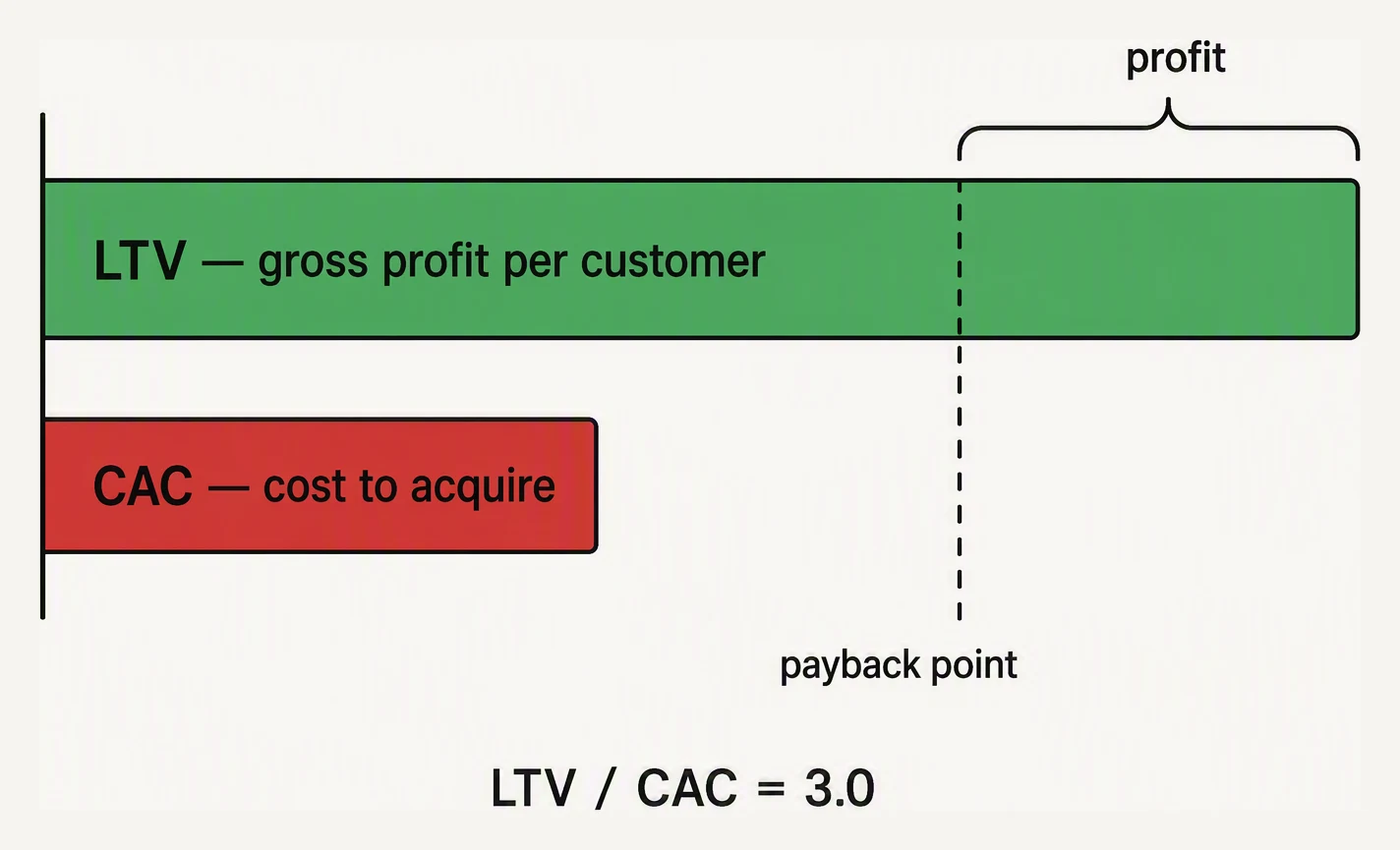
The whole business is this one picture, repeated.
ARPU — what one customer pays you each month
ARPU stands for Average Revenue Per User per month. It’s the simplest input: if 1,000 customers collectively pay $40,000 a month in subscription fees, ARPU = $40,000 ÷ 1,000 = $40/month.
ARPU is revenue, not profit. To get to profit we need the next piece.
Gross margin — how much you actually keep per dollar of revenue
Gross margin (expressed as a percentage) is the share of revenue left after the direct cost to serve each customer — the servers, support staff time, and payment-processing fees that scale with each user. If ARPU is $40 and those direct costs are $10, gross margin = ($40 − $10) ÷ $40 = 75%.
Monthly gross profit per customer = ARPU × gross margin = $40 × 75% = $30.
That $30 is the money that actually flows toward covering your business — and eventually toward profit.
Churn — how long a customer stays
Churn is the share of customers who cancel (or “churn out”) each month. If 4% of your customers cancel in January, monthly churn = 4%.
Churn controls how long a customer stays, and therefore how many months of gross profit you collect. Because customers leave at a roughly steady rate, the average customer lifetime follows a clean formula:
Average lifetime = 1 ÷ monthly churn rate = 1 ÷ 0.04 = 25 months.
At 4% monthly churn, the average customer sticks around for about two years.
CAC — what it costs to win one customer
CAC stands for Customer Acquisition Cost — the fully-loaded sales and marketing spend needed to win one new customer. “Fully-loaded” means everything: ad spend, sales salaries, commissions, trade-show booths, and the 20% of the CEO’s time spent on sales calls.
Total sales + marketing spend last quarter ÷ new customers won = CAC.
For our example: CAC = $280.
LTV — the payoff from one customer’s whole life
LTV (Lifetime Value) is the total gross profit one customer brings from sign-up to cancellation.
LTV = monthly gross profit × average lifetime = $30 × 25 months = $750.
There’s a compact version of the same formula that’s easier to track on a dashboard:
LTV = (ARPU × gross margin) ÷ monthly churn = ($40 × 0.75) ÷ 0.04 = $750.
LTV vs. CAC — the moment of truth
Now we have both sides of the equation:
- LTV = $750 (what one customer is worth)
- CAC = $280 (what one customer costs to acquire)
- LTV:CAC ratio = $750 ÷ $280 ≈ 2.7×
The industry rule of thumb is LTV:CAC ≥ 3×. Why 3×? The 1× just covers the acquisition cost. The second × covers ongoing operating expenses (product, infrastructure, G&A) that aren’t in COGS. The third × is the buffer for risk, seasonality, and capital to fund growth.
Below 3× you’re alive but thin; below 1× you lose money on every customer you keep.
At 2.7× this business is thin — not drowning, but not healthy either.
The second metric investors watch is the payback period — the months of gross profit needed to earn back the CAC:
Payback = CAC ÷ monthly gross profit = $280 ÷ $30 ≈ 9.3 months.
The rule of thumb for payback is under 12 months for most SaaS. At 9.3 months this passes, but the LTV:CAC ratio is still marginal.
Try it — fix the business with the explorer
The widget below shows LTV and CAC as bars, with a 3× CAC marker. The health verdict and payback period update live. The defaults match the numbers above — LTV $750 vs. CAC $280, ratio 2.7×, verdict “thin.”
Try each lever in isolation and notice which ones move the ratio most:
- Lower monthly churn from 4% to 2% — what happens to lifetime and LTV?
- Raise ARPU from $40 to $50 — same churn, what ratio do you reach?
- Cut CAC from $280 to $200 — does that alone get you to 3×?
- Improve gross margin from 75% to 85% — how much does LTV shift?
Is each customer worth more than they cost?
LTV = (ARPU × margin) ÷ churn. The rule of thumb: LTV should be at least 3× CAC.
The churn experiment is usually the most surprising. Halving churn from 4% to 2% doubles the average lifetime from 25 to 50 months and doubles LTV from $750 to $1,500.
That pushes the ratio from 2.7× to 5.4× without touching price or CAC at all. Small churn improvements compound dramatically because churn sits in the denominator of the LTV formula.
The two rules of thumb — and their limits
| Metric | Rule of thumb | Our example | Verdict |
|---|---|---|---|
| LTV:CAC | ≥ 3× | 2.7× | Thin |
| CAC payback | under 12 months | 9.3 months | Passes |
These benchmarks come from decades of SaaS investing and are useful starting points, not laws of physics.
A hardware business with long customer lifetimes might accept 18-month payback. A marketplace with negative churn (expansion revenue from existing customers) can operate at lower ratios.
Always ask: what assumptions does our industry’s benchmark embed, and do they apply to us?
Unit economics in the wild
When a business is growing fast but burning cash, unit economics is the first question a board asks. If the unit is healthy (LTV:CAC safely above 3×), burning cash to acquire more customers is rational — you’re buying valuable long-term assets.
If the unit is underwater, burning cash only digs the hole deeper. Growth doesn’t fix bad unit economics; it accelerates the problem.
This is why seed-stage investors often care more about unit economics than revenue. A $500K/year business with a 5× LTV:CAC ratio is fundable. A $5M/year business with a 0.8× ratio is not — at least not without a plan to fix the unit before scaling it.
In one breath
Unit economics asks whether one customer is profitable — because if they are, growth is an accelerant, and if they aren’t, growth is gasoline on a fire.
Build it from four numbers:
- ARPU (revenue per user per month)
- gross margin (the share you keep after the direct cost to serve)
- churn (which sets average lifetime = 1 ÷ monthly churn)
- CAC (fully-loaded cost to win one customer)
They combine into LTV = (ARPU × gross margin) ÷ churn — the lifetime gross profit per customer.
Judge it two ways: LTV:CAC ≥ 3× (1× repays acquisition, 2× covers opex, 3× funds growth and risk) and payback under ~12 months.
Two traps:
- Compute LTV on gross profit, never revenue (the most common flattering mistake).
- Respect that churn sits in the denominator, so small churn changes swing LTV hard.
Practice
Quick check
A question to carry forward
Read back over the very vocabulary we just used: ARPU is Average Revenue Per User. Average lifetime. Average CAC. The whole apparatus rests on one quiet word — average — and on the assumption that an “average customer” is a real thing you can reason about.
But is it? In the unit-economics explorer, one whale paying $400 a month and forty users paying $5 can produce the exact same ARPU as everyone paying $15 — and those are completely different businesses.
So the question to carry forward is: when does the average customer not exist? The next lesson, averages that lie, shows why the mean quietly misleads on almost all business data and what the median and percentiles reveal instead.
It also shows why the gap between mean and median is often the most important number on the dashboard.
Practice this in an interview
All questionsMarket-sizing questions test whether you can decompose a complex number into estimable sub-components, make explicit and reasonable assumptions, sanity-check against known benchmarks, and communicate uncertainty without losing structure. The answer itself matters less than the reasoning chain.
Offline metrics often don't predict business impact, so you run a controlled online experiment: split live traffic between the current champion and the new challenger and compare a pre-registered business metric with a statistical significance test. You size the test for adequate power, watch guardrail metrics like latency and errors, and only ship if the lift is statistically and practically significant. Variance-reduction techniques like CUPED let you reach significance faster.
A north-star metric must satisfy three properties: it reflects the core value delivered to users, it correlates with long-term business outcomes (retention and revenue), and it is actionable — meaning teams can run experiments that move it. Choosing one requires articulating the product's value exchange and then stress-testing candidate metrics against those three criteria.
A retention drop investigation requires distinguishing between an acquisition-mix shift (newer cohorts are lower quality) and a genuine product regression (existing cohorts are performing worse). The two look identical in aggregate retention but have completely different fixes. Cohort analysis — plotting the D30 survival curve for each weekly acquisition cohort — is the first move.