Funnel Analysis
10,000 people visited; 360 paid. Where did the other 9,640 go — and which leak should you fix first? Funnel analysis answers both.
Written and reviewed by Shreyash Prashu Last reviewed
What you'll learn
- What a conversion funnel is and why it narrows at every step
- Overall conversion = the product of step rates, not the average
- How to find the biggest leak and why fixing it beats buying more traffic
- Quick math: lifting one step rate and watching the compounding effect
Before you start
RFM described the customers you already have. This lesson rewinds to the journey before that — the path a stranger walks to become a customer at all, and the steps where almost everyone quietly drops away.
You ran ads, wrote content, and earned 10,000 visitors this week. By Friday, the payment system logged 360 customers. Your manager asks: “Should we spend more on ads to get more visitors, or is something else broken?”
Funnel analysis is the tool that answers this precisely — without guessing.
What is a Conversion Funnel?
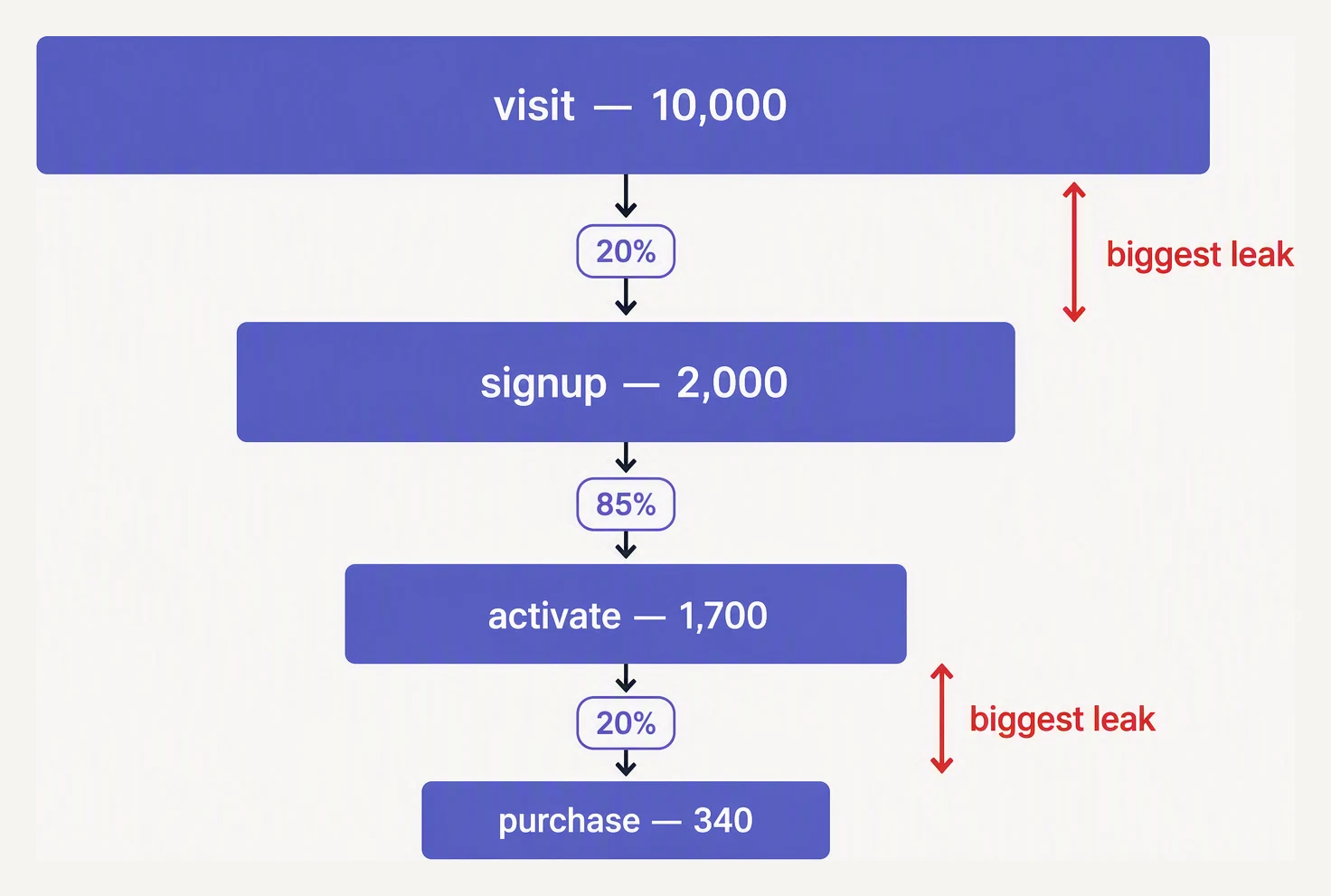
Fix the worst step, not the smallest number.
A conversion funnel is the ordered sequence of stages a prospect passes through on the way to becoming a customer — visit the site, sign up, activate (use the product enough to see value), then pay. The shape is a funnel because people drop off at every step: the pool narrows from one stage to the next.
At each step you can measure the conversion rate — the percentage of people who move from that stage to the next. Three step rates define our example:
- Visitors → Sign-ups: 32% of 10,000 visitors sign up = 3,200 sign-ups
- Sign-ups → Activated: 45% of 3,200 activate = 1,440 activated users
- Activated → Paid: 25% of 1,440 upgrade to paid = 360 paid customers
The rest — 6,800 people who never signed up, 1,760 who signed up but never activated, 1,080 who activated but never paid — are the drop-off at each step (the people lost before reaching the next stage).
Overall Conversion: Multiply, Never Average
Here is the number that surprises almost everyone.
The overall conversion rate is not the average of the three step rates. You multiply them:
32% × 45% × 25% = 3.6%So 360 paid customers out of 10,000 visitors — an overall rate of 3.6%. If you had averaged (32 + 45 + 25) / 3 = 34%, you would wildly overestimate how many people reach the end.
Why multiply? Because the rates are sequential gates. To reach Paid you must pass all three. The probabilities compound: if only 32% make it past gate one, the 45% at gate two applies to those 3,200 people, not to the original 10,000. Each step shrinks the pool that the next step acts on.
Finding the Biggest Leak
Drop-off in absolute numbers:
| Step | In | Out | Lost |
|---|---|---|---|
| Visitors → Sign-ups | 10,000 | 3,200 | 6,800 |
| Sign-ups → Activated | 3,200 | 1,440 | 1,760 |
| Activated → Paid | 1,440 | 360 | 1,080 |
The biggest absolute loss is at the very first step (6,800 people never signed up). But the worst conversion rate is Activated → Paid at 25%. That 25% is the biggest leak — the step where you are losing the largest fraction of the people who reached it.
Why focus on the worst rate? Because fixing it compounds. Lift Activated → Paid from 25% to 35%:
Paid = 1,440 × 35% = 504That is 504 paying customers instead of 360 — a 40% increase in revenue with zero extra traffic. The lift on one step flows through to the final number because every activated user who converts adds to the bottom line.
Try It: The Funnel Explorer
Drag the sliders to see how each step rate changes the paid count. Start by nudging Activated → Paid upward — watch how fast the final number moves compared with adding more visitors.
Where is the funnel leaking?
The biggest leak — not the last step — is usually where a 5-point fix buys the most customers.
The widget flags the lowest-conversion step in red. That red step is where your next experiment should live.
Why More Traffic Is Usually the Wrong First Move
The compounding nature of funnel rates means improving the worst step is usually the cheapest and fastest path to more revenue. Traffic is expensive; product and onboarding improvements are often one-time costs.
The Quick “What Should We Fix?” Checklist
- Write down all step rates.
- Circle the lowest rate — that is the biggest leak by percentage.
- Estimate the gain from lifting that rate by 10 percentage points.
- Compare the cost of that fix to the cost of buying equivalent traffic.
- Invest where the math is most favorable — almost always the leaky step.
In one breath
A conversion funnel is the ordered sequence of stages from first visit to payment, narrowing at every step. The number that surprises everyone: overall conversion is the product of the step rates, not their average — 32% × 45% × 25% = 3.6%, not 34% — because each gate applies only to the smaller pool that survived the previous one. Find the biggest leak by the lowest rate (here Activated → Paid at 25%), not the biggest absolute drop-off, because lifting the worst rate compounds through every later step: nudging it 25% → 35% takes paid customers from 360 to 504 with zero extra traffic. That’s why patching the leaky bucket beats pouring in more water — product and onboarding fixes are usually one-time costs, while traffic is a bill that never stops.
Practice
Quick check
A question to carry forward
The funnel ends at the cash register: 360 people paid. We treated “Paid” as the finish line — but for any business that bills more than once (a subscription, an app, a repeat purchase), it’s barely the starting line. Of those 360, how many are still here next month? In three months? The funnel can’t see past the first payment.
So the question to carry forward is: what happens to customers after they convert — and how do you measure whether they stay rather than quietly leak away? The next lesson is cohorts, retention, and churn: grouping customers by when they joined, tracking each group month over month, and reading the retention curve that decides whether all that funnel work compounds into a business or drains out the bottom.
Practice this in an interview
All questionsA metric drop investigation starts by confirming the drop is real — ruling out logging bugs and metric-definition changes — before hypothesising causes. Then segment by platform, geography, user cohort, and funnel step to isolate where the drop is concentrated, which points to the most likely root cause.
A retention drop investigation requires distinguishing between an acquisition-mix shift (newer cohorts are lower quality) and a genuine product regression (existing cohorts are performing worse). The two look identical in aggregate retention but have completely different fixes. Cohort analysis — plotting the D30 survival curve for each weekly acquisition cohort — is the first move.
Engagement is multi-dimensional: breadth (how many users engage), depth (how much they do per session), and frequency (how often they return). A robust engagement framework stacks these three layers into a metric hierarchy and links them to retention curves, because engagement that does not predict long-term retention is usually noise.
Offline metrics often don't predict business impact, so you run a controlled online experiment: split live traffic between the current champion and the new challenger and compare a pre-registered business metric with a statistical significance test. You size the test for adequate power, watch guardrail metrics like latency and errors, and only ship if the lift is statistically and practically significant. Variance-reduction techniques like CUPED let you reach significance faster.